A Fray of Four Fiefs
A sequel to Ember of the Fallen Kingdom
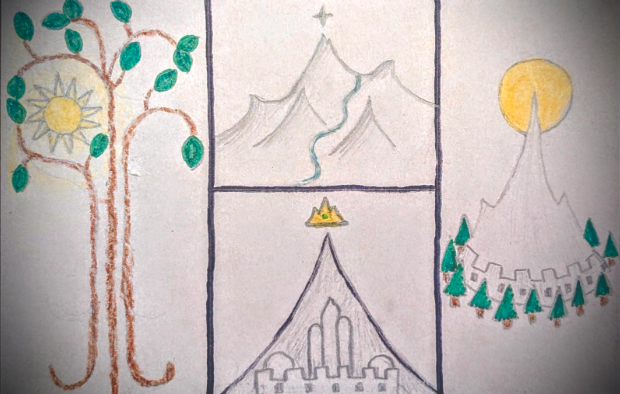
Artwork by Winston Coady
Chapter One: Where Five Paths Meet
In many a corner could be found the King Alfon Alderstar of the Four Fiefs of Athemor: perhaps pondering wisely upon the seat of his throne, or orating a powerful speech from atop the Royal Rostrum of Cliffenheim; feasting in great halls laden with goblets of mead, conceivably, or gazing upon the four realms he had so nobly made one. Though, in the winter following this unification of the Kingdom of Athemor, the elf could be found only poring feverishly over heaps of old scrolls.
It was the eve during which Alfon would reveal his discoveries, though to only the most trusted souls he knew—and in the kingdom’s most protected, most abundant center of literature. First came his queen, Embla, through the doors of the Crestwood Royal Library—where it seemed even the books and scrolls bowed to her in honor of the library’s very namesake: Queen Embla Crestwood and her father, Fraxinus. These two nobles had been the first humans ever to shelter an elf in Cliffenheim—secretly—when Alfon Alderstar arrived in the city as a spy traveling between Cliffenheim and his elven homeland of Súnimanta. This was before he, along with the siblings Odin and Hilda Wrenstone—the library’s next visitors—had met by chance in the ancient shrine of Tamikúmu long ago and discovered the treachery of Cliffenheim’s former Berg dynasty.
And this eve, striding shoulder-to-shoulder through the library, Alfon’s two most devoted advisors now rushed merrily into their gracious lord’s embrace. Both Odin and Hilda, of course, were dying to know: “How are the little angels?”
“Such joys!” Embla cheered. “I can see already a royal future for the tots!”
“Mere inches from the throne!” the king chuckled. “Where are Little Alfon and Alfwyn now?”
“I sent my father to give them a bath.”
“Splendid. Then, we await one last visitor.”
Hardly had he spoken when through the doors came a tall, nobly-dressed young man smiling at them with a narrow mouth beneath sharp cheekbones and eyes that seemed to express more than he said. All four bowed at his arrival, and thus spoke Alfon: “Greetings, Lord Inwid Ofurling, son of Duke Vassal-lord Felsen, heir of Ofurburnin and the Duchy of Ostenfeud! Much have we all to discuss during this hour, though perhaps for Your Highness I may bear the most important message of all!”
There was intrigue in the eyes of Embla and the Wrenstones, though—as Alfon noticed—a puzzled expression as well. Clearing his throat, the king announced: “I suppose you three wish for an explanation as to why His Highness has graced us so with a visit!”
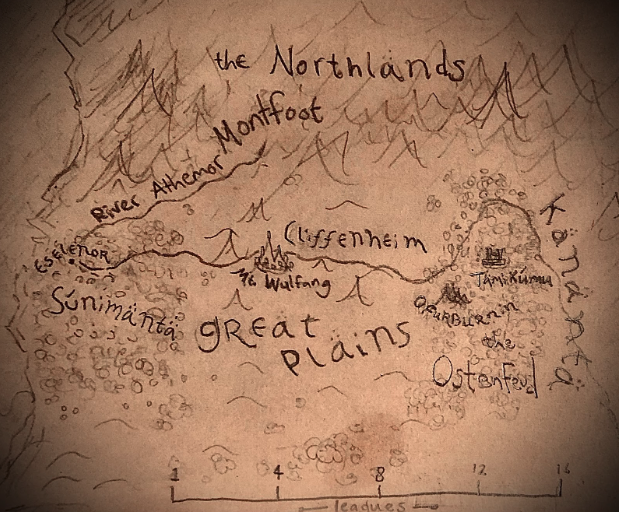
Artwork by Winston Coady
Chapter Two: A Five-Thousand-Coin Order
“Ever since the day when archaeologists began marching into the ancient halls of Tamikúmu,” Alfon explained, “Lord Inwid Ofurling has managed the temple’s excavation with precision that could open new doors for the future of the Four Fiefs.” The elf’s voice echoed across stonemasoned walls and between rows of book-laden shelves immeasurable in both height and vastness. “His noble leadership and frequent meetings with me have led to discoveries of ancient Kananti literature that may prove to be more influential than Jasifi’s Scroll itself.”
An awed silence fell over them all. There was a glint in the listeners’ eyes akin to the shimmer of a jewel.
“Jasifi’s Scroll,” Embla uttered under her breath. “The scroll that toppled a dynasty. Brought death to a tyrant, and peace to a kingdom. The scroll that named you king of Cliffenheim.”
Alfon smiled. “To unearth buried wisdom and elven prophecies… we could heal the enmity that remains in Athemor. We could expose this fiend they call the Rallier… this terrorist who led the raid on Eselenor that fateful night months ago. That night when the last lord of the Iselon dynasty was assassinated, and when…” His voice faltered. A tear could be seen sliding from the elf’s eye. “When they took my sister’s life as well.”
The story was known already to them all. Alfon’s nephew, Keloras, had washed up at dawn on the banks of the Athemor River near Cliffenheim. Embla, walking along the bank as if led by fate, had drawn him out of the water. Shivering, half-drowned, grief-stricken, nearly unconscious… all the young elf could utter was: “My mother’s gone.”
“No,” Embla had told him, “she’s still with you, Keloras, still a part of everything she passed on to you. And still there is no shortage of those who care deeply for you.”
“A son you shall be to me,” Alfon had declared upon the eve of that day. “A third child of mine. And I shall be your father. The bond between us shall be far stronger than any mere uncle-nephew relationship.”
“Súnimanta was in ruins after that night,” Inwid murmured. “Leaderless, wary of men, famished… until you made that dying kingdom a fief, led from thence by none other than Lord Keloras. And it wasn’t long before all four lands became one. Cliffenheim, Súnimanta, the Northlands… and, finally, the Ostenfeud.”
“Why, Inwid,” Hilda Wrenstone inquired, “did Ofurburnin pass its territory so readily beneath Cliffenheim’s crown?”
A silence followed for the next moment. Then: “I never quite understood my father’s decision. Perhaps he feared a kingdom once held by man was stumbling too quickly into elven control, and wished to become one with the rule of Athemor. Or perhaps there’s more to it than he’s made plain.”
“Alfon,” spoke Odin Wrenstone, “what think you of these tidings I’ve heard tell, these news of the Súnimanti’s urge to reclaim their homeland?”
“A fine question,” the king replied, “and one that demands faster restoration of Tamikúmu. What will happen when an influx of elves is crammed into the forest of Kananta, where every footstep will leave a mark on the already fragile land?” Alfon cleared his throat. “I’ve made up my mind to grant five thousand golden coins towards the haste of the Ofurburnish excavation.”
The king’s gaze passed from the appalled Wrenstones and Embla to the beaming marquess. As Inwid rose from his seat, an uncontainable ecstasy seemed to twist his smile like a river’s bend. “My gracious lord, Your Majesty’s generosity will not be in vain.”
Alfon rose slowly to his feet, smiling at him. “Meeting dismissed!” His booming voice echoed across the chamber.
Chapter Three: A Knife in the Study
One week after Alfon’s grant, the jagged crest of Mount Wulfang stabbed like a blade into the sinking sun. At its flank, the winding streets of Cliffenheim echoed with the clip-clops of Inwid Ofurling’s steed—until the great beast halted before the gates of the castle.
Listening from atop a high balustrade of the palace, Odin and Hilda Wrenstone could discern the voice of their king amidst the eve’s silence. “...three hours’ time past sundown, and by the Crestwood Library’s hearth…” And all that they heard next was the distant cawing of ravens.
The feast was no less silent, save for the minstrel’s hushed lay marking Inwid’s arrival. Every so often, Hilda watched the marquess glance at her for an instant—as if whispering something with his eyes.
By the time every goblet sat empty of mead—and once the sun had departed at last—so too did the nobles take their leave for want of rest.
Three hours had passed since the sun’s passing. Three hours had Odin Wrenstone tossed and turned in restless sleep. And for three minutes had he laid roused in bed, deathly-still, unable to resist the urge to grope across the bedstand for his dagger… feeling naught but cold wood beneath his fingers.
“Hilda!” A series of knocks struck against his sister’s door. As soon as she appeared, Odin’s tidings burst forth. “My dagger’s missing. Though I believe I know where it is.”
The eyes of Alfon Alderstar and Inwid Ofurling glinted with the ginger glow of the hearth. “I must say,” the king rumbled, “I expected better, for so generous a grant. Five thousand golden coins, yet a decline in the influx of documents.”
His eyes followed Inwid’s tense hands as they reached into his pockets, hid there like a groundhog, peeked out, scuttled back down into his pockets…
“Aye, sire, aye… It was indeed a most luckless week for us, and I apologize. Perhaps, my lord… perhaps a greater sum of funds…”
“Nay.” Alfon’s voice was like a cold stone. “My grant was far greater than plenty. The demographers state that Ofurburnin’s head count has soared of late. Cliffenheim’s folk have flocked to your city. Ofurburnin’s might has all but dwindled—though I should hate to spurn its name during the Council of Eselenor next eve.” His teeth clenched. “Reveal your answer, Felsen’s son—and whatsoever you fiddle with in those pockets!”
Alfon’s heart thundered in his chest. He’d hearkened to the rumors, and seen it firsthand—how it could enslave a man, devour his wit, refuse to let his attention stray from the thing.
Inwid’s every muscle froze. He stood before the king, motionless, staring into his eyes with an impenetrable expression. When the marquess’s hand emerged, Alfon realized his misjudgement—and was blinded by a flash of steel in the glow of the hearth and the moon.
Chapter Four: A Shard by the Fire
Alfon’s throat trembled before the dagger’s flashing point. The elf stared with disbelief into Inwid’s bloodshot eyes, pressing his back desperately against a corner where the wall met the end of a slender shelf. Many books shifted behind his weight like reeds yielding to the wind, and some tumbled from the shelf as stones drop from great summits. The hall echoed with thuds of fallen leather and crinkles of pages creasing on the floor behind… followed by close footfalls, the shing of an unsheathed blade, and the sudden scrape of steel across wood.
As cleanly as an arrow flies from the bowstring, Hilda Wrenstone’s sword shot through a gap in the shelf with a flash off the dagger in Inwid’s hands. Alfon gasped with awe, watching it slide to a halt an inch beneath Inwid’s throat.
“Drop my knife, thieving traitor!” Odin bellowed, leaping from behind the shelf and hurling his strong arms around the marquess’s ribcage.
Inwid Ofurling stood thus for several moments: motionless, clasped in Odin’s arms, barred by Hilda’s sword, already feeling his once-resolved arm faltering under the weight of defeat.
“Inwid…” Alfon’s voice, quivering like a harpstring, started as a plea—a call to an old friend—but ended as a demand. “Lower the blade. And tell me the truth, or else…”
Two words seemed to hide in his tone, words he feared even to fathom. Interrogation. Torture.
The marquess obeyed Alfon’s first order. Slowly, he withdrew the dagger from Alfon’s throat and stared at the weapon as if it held the fate of the world itself.
Neither Hilda nor Odin beheld what came next. All they caught sight of was a swift, inward thrust of the blade. All their ears witnessed was a sudden pierce, a cry of pain, and the deathly thudof a body striking the floor.
Hilda rushed to their sides. There, sprawled powerlessly across the floor, lay Inwid Ofurling, son of Felsen, heir of the Ostenfeud. Amidst the dimness, half of a knife could be seen glinting in his chest.
Alfon dropped to his knees beside Inwid’s body, clutching the marquess’s shoulders. “Why, Inwid, why… oh, my dear boy, for what?”
Inwid’s eyes rose weakly to meet Hilda’s. A tear slid down his cheek. “You… Hilda…” His voice was a rasp. “You w-would… have been my duchess…”
Inwid’s head lolled back. It struck the floor like a fallen pillar.
The next few minutes hung heavily with a grim silence. None knew what to say. When the firewood seemed to shift in its iron rack and ignite new flames, feeding the hearth’s light brighter once more, the king’s eyes caught sight of something resting beneath the fallen marquess’s waist—something none of the three dared touch. It shimmered softly, with a blood-red hue and a crystalline sparkle—so very minuscule in size, yes, but fraught with an evil Alfon had known and feared his entire life.
Chapter Five: The Schism is Born
“Several hours ago, in the dead of night,” announced Queen Embla, “an assassination attempt was made on King Alfon Alderstar.”
Thousands of gasping Cliffenheimians were gathered beneath the tower, faces pale as ivory and softly illumined in the dawn’s light.
“I was not present to witness the tragedy… And perchance that is why only I can tell it comfortably.” The queen glanced solemnly at her husband and the Wrenstones. “Odin Wrenstone’s dagger Lord Inwid Ofurling did steal, and with it confronted our king after their meeting in the library. In suspicion the Wrenstones burst in to seize him, and the traitor—fearful of interrogation—grasped his final chance for control.” Embla cleared her throat. “Inwid Ofurling ended himself with the very dagger he had held to our king’s throat.”
Gasps surged no longer over the crowd. There was silence now—grim, dark, and yet hollow with an unsurprised sense of confirmation.
Odin and Hilda stood shoulder-to-shoulder, armored, grasping their weapons. “My blade,” Odin whispered, “will be forever stained with his blood. Great was my dread on hearing those creeping footfalls in my room. No greater curse could befall me. Lo! would that any other knife had he chosen, any other path had he taken.”
“I’m sorry,” Hilda whispered. “You two suffered… much friction. That knave was smitten with me, you know—and I’ll warrant he saw you as more than just a threat. But oh, let us hope that so bitter a feud spreads not any further!” She gazed into the distance—over the plains and the eastern forest, where dawn rose now over the towers of Ofurburnin.
“Such we hoped,” Odin growled, “on this very rostrum, months ago. Remember what we thought we’d escaped? And how old Berg fell? How the thing slew him? That plummet, those fluttering robes… the fire that swallowed him. We thought both were gone.” Odin laughed grimly.
“Don’t be gloomy, Odin.” Alfon shot a glance at him. “We’ll shatter that trinket. And whatever bit of Berg’s spirit still festers within. But we blessed well won’t let the word spread.”
The king strode toward the balustrade, raising his voice. “There is reason, my people, to believe that Inwid Ofurling was indeed the Rallier. Since the birth of my reign, he and his followers have sought tirelessly to stain our kingdom with elven blood. But we’re not to trust Ofurburnin any longer. This night, I shall speak with the lords of Súnimanta. Together, we’ll decide on how the elves will return to their homeland in the forests of the Ostenfeud. Queen Embla will scour the city of Ofurburnin for secrets, and Duke Felsen will be questioned.”
Alfon raised his sword to the sky. “Let not this rift seize our kingdom!” The crowd burst into cheering—thunderous yet edged with fragility, as if wondering what would come if one plan went awry.
Chapter Six: The Economist’s Truth
“The name of Athemor grasped glory,
Among its days of newfound bliss:
Untouched by strife or battles gory,
‘Til peace did Felsen’s realm dismiss.
Misused were funds the king had poured
Into the plan of his beliefs;
A traitor’s blade came near our lord,
And roused the Fray of Fourfold Fiefs.”
The minstrel’s song ended almost as soon as Queen Embla could spot the city.
There it was: Ofurburnin. Capital of the Ostenfeud. A major center of mankind’s rule over the elven forest of Kananta. And, of late, a threat to Athemor’s unity.
Embla glanced back. Several paces behind her steed, one horse-drawn cart bore a lump shrouded in translucent fabrics. It was like staring through silk, or a spider-web, or a layer of mist. Beneath was the body of Inwid Ofurling: pale, lifeless, but deep in rest—as if conscious of his return home.
Odin and Hilda Wrenstone flanked the queen on both sides, grasping their swords as they crossed a bridge over the Athemor River. Like Cliffenheim, Ofurburnin was built into a mountainside within the encasement of a great rampart. Its stony streets wound up the slope like a serpent, and its towers loomed above all else.
The Wrenstones shuddered. Both had been the first ever to discover mankind’s theft of elven architecture, which embraced the intertwinement of trees with stone. Ofurburnin’s rampart, however, stood bare of greenery—like a woodland robbed of trees. As the expedition passed through gloomy streets thronged with staring commoners, the faint whiff of smoke reached their nostrils.
“I want Inwid’s body taken forthwith to the Ducal Palace,” Embla announced, gesturing to the crown of the city. “I shall speak with the duke myself. Odin, Hilda—you two will handle the task of questioning Count Feoman, Ofurburnin’s chief economist.” Embla pointed to a structure. “That is where he awaits you.”
Count Feoman of Ofurburnin was sharp in all manners: keen of mind, piercing in speech, angular of facial features, and dressed in robes of striking colors. He spoke under his breath, as if afraid to answer the Wrenstones’ question. “The funds which King Alfon so generously granted us, those five-thousand goldings which His Majesty placed in Ofurburnin’s hand… Well, it pains me to say that not one coin went in the direction King Alfon had desired.”
The Wrenstones stared at him, speechless.
Feoman smiled. “What I tell you now, Odin and Hilda Wrenstone, could cost me my wealth, my counthood, my name as economist, even my life.” His eyes seemed to hold a kind of sorrow. “But a man’s faith is in his kingdom. Mine lies in the unity of Athemor, not in the traitor who dwells at the Ducal Palace.” The count gave a dry chuckle. “I am unsure of how exactly Felsen made use of the funds—but I know, with all the certainty in my heart, that none was spent on excavation efforts.”
Chapter Seven: The Lord of the West
Eselenor was the mightiest of all elven cities: nestled in the northwest of the woodland, looming over the river-bend, and built upon a great web of interconnected bridges and tree-houses that seemed to bind the great forest together. Alfon’s steed passed at the break of noon over Eselenor’s main bridge, where soldiers bowed and minstrels sang over the strum of harps; and ere long he halted, for not far ahead stood the lord of Súnimanta.
“Keloras!” Alfon beamed, sliding from his saddle to embrace the elf. “Long has it been since our last meeting, my nephew! You have grown, clearly—and seized the title of Vassal-lord with such readiness!”
“Greetings, uncle, my king.” Keloras smiled. “Your arrival brings joy to all the land. All councillors wait eagerly to welcome His Majesty, King Alfon Alderstar, lord of the Four Fiefs of Athemor.”
The two elves found a quiet region of the forest in which to pass time together, for the Council of Eselenor was not to begin until evening. “I was relieved beyond measure,” Keloras mentioned, “to hear that you came through it, alive—that wicked assassination attempt.”
Alfon did not respond for several moments. Then: “An evil night, it was.” The king paused in his tracks, and his voice fell to a whisper. “The marquess was too young, too innocent—he should not have gone that way. I tell you, Keloras: It was Felsen, damned Felsen, that lazing, cowardly, serpent-tongued bastard of a duke! Embla will have many questions indeed to ask of him, and I don’t expect she’ll hide one answer during the council.”
A sorrowful look passed across Keloras’s face. “They say Inwid was the Rallier, yes? Well, then he was responsible for my mother’s death.” The elf gestured ahead to a small wooden bridge spanning the Athemor River. “That is where they took her life, on that night long ago—where many an arrow pierced her body, and where she sheltered me with her arms for the final time. That raid was fleeting, aye—too much so to spare me a moment’s time, that I could bid my mother farewell. I leapt into the river, and drifted down it half-drowned the whole night—and that was the end of it.”
“I’m sorry, Keloras.” Alfon sighed. “It was a terrible—”
“Never,” the elf interrupted, “will I forgive the race of men for that atrocity—nor even the elven lords who say that men can frolic into the lands our people have stewarded for centuries.”
“It is equally my burden to bear.” Alfon raised his voice. “I lost my sister that night, Keloras. My homeland was wounded. And my desperation to support the race of elves, to grant them everything they lost in Tamikúmu… Well, that is why I believed I needed Inwid. I should never have trusted him, Keloras, should never have been such a damned fool——”
“No,” Keloras growled. “You should never have put trust in the name of Ofurburnin. You endangered the race of elves, uncle, and all the people of Athemor with them!”
“Leastways it’s not a measly fief I govern!” Alfon snarled. “My responsibilities are far greater than yours, Keloras—responsibilities a young vassal-lord could never understand!”
All of a sudden, there came a voice from behind them. “Lord Keloras, more visitors wish to greet you.”
“I shall see you at the council, uncle.” There was a look of frustration in the vassal-lord’s face, even as he turned to follow the messenger.
Alfon remained there, in the quiet wood, for several minutes. Something had seized him, he knew, compelled him to argue with the young elf. His hand fell into his pocket, and he fingered it: the coldness, the crystalline smoothness. He wondered—with a terrible fear—if this shard would enslave him, as it did Inwid and the kings who ruled before Alfon Alderstar.
Chapter Eight: The Duke and the Queen
Through lavish halls strode Embla Crestwood, and past towering walls adorned with the brightest gold; vast frescoes swallowed the ceiling that stretched like an outspread arm, boasting grand images of the olden deeds and heroes of Ofurburnin, which men have forgotten today.
Wide grew the queen’s eyes. For at the very end of the hallway, looming over an archway before the throne room, was one great fresco that dwarfed all else: massive, terrible, but brilliant, and in the likeness of none other than Felsen Ofurling himself. The duke’s eyes gleamed with an indecipherable light, and flitting all across the painting were faint images of what appeared to be flames.
Grander yet was the chamber where sat the duke himself. The chandelier blazed, the gilded walls glimmered, the light gleamed upon guards’ armor. There, seated upon an elevated throne, was Duke Felsen Ofurling, clad all in flowing robes, grasping his golden scepter; larger was he than all others in the room, and the throne seemed to tremble beneath his massive weight.
Yet—as she looked closely—Embla saw that there were faint lines of sleeplessness beneath his eyes, which were pink and bloodshot, and under which traces of dried tears caught the light.
“More golden,” Embla announced, “is the gleam of your palace than last I saw it, Felsen Ofurling.”
The duke remained in his seat, smiling subtly. “Indeed.” His voice was like a tree whose bark has flaked and crumbled. “Ofurburnin’s days of glory have bloomed, my queen, like a great golden flower.”
“And what pollen has fueled this blooming, if I may ask?”
Felsen seemed at once to detect what message lay in Embla’s question. For a moment, he remained in silence.
“My realm could not have reached its greatness,” he sighed, “without the ingenuity of my dear boy.”
There was an aversion in his tone, Embla noticed—an evasiveness to mention the misuse of funds.
“You have my deepest condolences, Felsen. Inwid was an intelligent boy. I know not—and will never know—why he did such a thing.”
“Inwid was the most pure-hearted boy I knew.” Felsen paused. “And, like his father, he was a lad of ambition. Every evening when his steed came trotting wearily from Cliffenheim, my lady, there was an utterly drained look in his eyes. King Alfon and I—we went too hard on him, the poor boy. He was torn, Embla, torn between the two of us—and knew his life was unsalvageable. Clearly…” The duke heaved a deep breath. “Clearly, he did not relish taking orders from an elf.”
“And what of the funds?” Embla boomed, irked at his evasiveness.
“The funds,” Felsen claimed, “have greatly fueled excavation efforts in Tamikúmu.”
“Is that right? Then I wish next to visit the shrine, that I may judge the progress myself.”
“The temple,” Felsen replied, “is not at present available for those uninvolved in its excavation. Besides, you must depart soon—no? Ere you go, my lady...” He gestured to three fair young women standing in the right corner of the chamber. “Your nephew, the elf-vassal. He is unwed, aye? Well—in compensation for the incident—I offer him all three of my daughters’ hands as a gift to your family.”
“A generous gift,” Embla responded, “but I would rather not sully the name of House Alderstar with polygamy. I hate to narrow time, Felsen, but the hour grows late. I must be on my way. Farewell!”
Embla gave a nod of the head. Then, she turned and strode to the exit of the chamber. No response came from behind.
Chapter Nine: The Council of Eselenor, Part One
The time had come. All the lords and councillors whom Alfon had summoned to Eselenor now gathered in one great ring upon the westernmost hill, which glowed in the golden light of the sundown.
“Their eyes,” Embla muttered to the Wrenstones, “must be locked on one another’s faces.”
“Or,” Hilda Wrenstone offered, “perhaps gazing into the brilliant Sun as she dips into the West.”
“Nay.” Odin Wrenstone squinted at the crown of the hill. “Their eyes face the east. They watch us, they expect us—they await us.”
Ere long, the three steeds halted before the gates of the pavilion, beneath whose roof the council was gathered. One by one, they were transferred from their saddles to their seats near the king, and at once the Vassal-lord Keloras Alderstar rose.
“Lords of Athemor’s realms, leaders among men and elves alike, rulers and diplomats and warriors of our land—we gather this evening to debate how the West-elves of Súnimanta will respond to Ofurburnin’s treachery.”
Members of the council grew tense and pale, glancing uneasily at one another.
“Lord Keloras, my nephew.” Embla rose suddenly from her seat. “Let it be known to all that Ofurburnin’s faithlessness has gone beyond simply an assassination attempt. The duke claimed Tamikúmu was in good hands; he would not let me see it. The palace had been embellished; he did not explain by what means. And for you, Keloras…” Embla’s force faltered. She heaved a breath. “For you, he offered the hands of his three daughters.”
“I beg your pardon?” There was a growl in Keloras’s voice. “How dare he insult me with offerings of polygamy! I will not take Felsen’s witches, lest they speak deceit in my ears. I scarcely believe it!”
Odin rose from his seat. “Her Majesty speaks the truth. While our lady questioned the duke, Hilda and I spoke with an Ofurburnish economist by the name of Count Feoman. He answered our queries with honor, and to him we owe a great deal of our findings.”
“That is right,” Hilda added, “for he said with certainty that King Alfon’s funds were misused by Felsen. Judging by the mystery shrouding Tamikúmu and the embellishment of the Ducal Palace, it is clear that Felsen has not followed our king’s orders. He has directed the funds towards his own selfish purposes!”
Anger grew in Alfon’s eyes, and uneasy murmurings passed across the council. “I want everyone seated,” Keloras ordered, and the three speakers obeyed. “From what I have gathered, there exist no arguments for trusting the traitor that is Felsen. Do any objections remain?”
The council fell silent, and not a murmur lived on. All eyes stared at Keloras, restless, awaiting his following statement.
“Good.” The vassal-lord gave a weak smile. “We move now into the second topic of our council. Thus far, we have discussed the abysmal deeds of the Ofurburnish—how they have marred the eastern lands once stewarded by the elves.” Keloras paused. “No longer will we speak of the Ofurburnish. Now, we will speak of the elven people—how they will reclaim the forest of Kananta once and for all!”
Chapter Ten: The Council of Eselenor, Part Two
The Sun was dipping into the western seas like a stone sinking in water, casting a great shadow across the indigo sky. The gold of Eselenor’s foliage was waning into a gray hue, but Keloras’s face caught the last light of the evening.
“Centuries ago,” the elf announced, “The Kananti, an elven people, were banished from their forest in the east. The race of men seized everything they possessed, and all elves retreated to these western lands. For centuries, few elves dared venture back to their homeland—a place said to hold one of the Two Jewels within the heart of Tamikúmu.”
Alfon’s face grew pale. He felt a coldness seize him, and whispers taunted his mind: the shard in his pocket had been named. None but Odin and Hilda Wrenstone, he realized, knew it was in his possession.
“You all know the story,” Keloras continued. “Our king and the Wrenstones broke in— learning the truth about men, snatching the jewel, and in turn having it snatched from them—then rushed straight to Cliffenheim and exposed King Berg’s treachery like a chink in the wall.”
How strange, Alfon thought to himself, that I found this jewel, and later thought it destroyed—only now to have it find me. Fate works in ominous ways.
“Yet still,” Keloras went on, “the forest of Kananta remains beyond the grasp of the elves. They have suffered what I call ‘waning’—a sense of longing for the east, felt even by those who have never seen Kananta’s light. Strength is fading, my people. The land is dying. If we return not to the place of our origin, if we let our people forget the magnificence of Tamikúmu… Felsen will defile the land before we can act.”
Alfon rose suddenly from his seat. His long golden hair caught the sundown. For a moment, only the two of them stood: uncle and nephew, king and vassal, leaders of the elves.
“Lord Keloras, my nephew.” Alfon gave a warm smile. “While I respect the viewpoint of your faction, I would deem immediate action unwise. Aye, Felsen may be wounding the land as we speak. But one cannot leap into a burning structure without first knowing what paths and obstacles lay within. We must remain in patience, I say, and attempt to reason with Felsen ere the elves put themselves at risk. I promise you: I will do everything in my power to settle matters with the duke.”
For a long moment, Keloras remained silent. Then, with his brow furrowing, he shot: “And did you prioritize, did you acknowledge any of our kind before absorbing Súnimanta into your kingdom?”
Whispers and murmurs traveled across the crowd.
“Keloras…” Alfon grew pale. “I wished not to conquer, but to support my people. The famines, Kel—”
“Perhaps we then are entitled to the equal right to conquest.” Keloras raised his fist. “My people, I ask you now: Stand you for the rights of the elves, or for the will to remain idle?”
“The rights of the elves!” Countless council members leapt to their feet, cheering and raising their fists. “We stand for the rights of the elves!”
“Very well.” Keloras gazed across the forest of Súnimanta. “The travelers will be mustered tomorrow. Send word to all corners of the land!”
Then the elf noticed that Alfon was smiling at him, smiling with pride and approval; and he saw that the queen and the Wrenstones were clapping their hands and nodding with admiration. Then he was filled suddenly with joy, and rising to a great stature, he cried: “Reborn anew will be the Elves of the East!”
Chapter Eleven: The New Heir
Billows of smoke spiralled into the black sky above Ofurburnin. Dots of red fire speckled the city, and a host of soldiers marched toward the front gates of Ofurburnin. Upon their shoulders they heaved a litter bearing the body of Inwid Ofurling, dead marquess of the Ostenfeud, the heir who had taken his life one night ago.
“Open the gates!” boomed Duke Felsen Ofurling, who stood upon the city’s rampart. And like a great beast widening his jaws, the gates of Ofurburnin were heaved open at his command. Through marched the soldiers, who after a time reached the banks of the River Athemor at the city’s foot. There they loaded the corpse into a great wooden barque filled with gold and jewels, which glittered softly in the moonlight. Then a torch-bearer set fire to the barque, and at once they all pushed it downstream.
All of Ofurburnin watched, with tearing eyes, as this mass of fire floated northward, consuming the young man who would have been their heir.
“Tonight,” bellowed the duke, “we honor the soul that was Inwid Ofurling, rightful heir and marquess of Ofurburnin and the Duchy of the Ostenfeud, my son. A noble man was he, and a tragic one at that—for the overwhelming demands and expectations of Alfon Alderstar drove him to madness. It is with pride, and not with shame, that we lament his suicide—the sacrifice he made to keep Ofurburnin’s secrets out of elven hands. While the loss of Inwid has forever wounded our duchy, it has permitted us to look upon a new heir.”
The duke fell silent. Heavy drumbeats echoed throughout the city, and in his direction came the sounds of blaring trumpets.
Tum… tum… tum… A distant clanging approached, and Felsen knew they were footfalls. Striding across the rampart of Ofurburnin, clad all in glimmering steel armor, raising his great mace to blot out the moon, was the new heir of the Ostenfeud, approaching to kneel before his duke.
“Fenwid Ofurling,” thundered the duke, “marquess of Ofurburnin, herald of our city, chief of warlords, I hereby declare you the rightful heir of the Duchy of the Ostenfeud.”
The citizens roared, thrusting to the sky their weapons and flaming torches. “Any man,” Fenwid bellowed, “any one soul who dares stand in my path—be he of Ofurburnish or other blood, I say—will soon be naught but pulp beneath my mace.”
“I have a task for you, Fenwid,” announced the duke. “We know that your brother carried a jewel shard on the night of his death. I’ll warrant Alfon has it now, all snug in Eselenor at his council.”
“And would you like it back, Father?”
“I want more than the shard. I want the exodus assaulted, and I want the remnants of Tamikúmu obliterated.”
“I’m afraid the forests are too dense for efficient—”
“Burn them, then!” Felsen raised his voice. “I care not how sacred those trees are to our enemies. They lost possession of this land centuries ago.”
“And the assault, Father? How many men shall I—”
“None.” The duke grinned. “We will not be the ones to attack. Let us view this as a test, a trial of the loyalty of our allies. Go to the Northlands on the morrow, Fenwid, and ask if the men there can prove their prowess in battle.”
“It will be taken care of, Father.” Fenwid glanced at the palace. “Shall we head to the feast?”
“Nay.” Felsen’s voice was a whisper. “I will not eat. I will not drink, nor will I sleep.” He gazed at the mass of fire flowing downstream. “I will not find rest until the death of my son has been avenged.”
Chapter Twelve: A Weapon Long Rested
“The crowds were roaring, chanting,” Alfon whispered. “Four fighters entered the arena of Cliffenheim, Keloras, one of whom was your father. Elves and men lived in separate realms, then, in fierce competition. King Berg III of Cliffenheim, the worst tyrant these lands have known, sent his two sons to challenge in melee the two champions of the elves.”
Alfon rose from his seat, pacing about the noble chamber. “Your father, flanked by the lord of Súnimanta, charged forth with his lance and smote down his opponent. The other prince cast down his weapon and sprinted to his brother’s side, and lo! the wounded combatant, blind and desperate, thrust high his spear believing he would pierce your father.”
“But he did not,” Keloras whispered.
“Nay. It was his own kin that met the spearhead. Brother fell by brother—who fell by one much like a brother yet made alien with lies and hate. Yet in their last minute, when both brothers lay coated in each other’s blood, they grasped together that mighty shaft and with it grazed your father’s shoulder.”
“I reckoned it was a minor wound,” Keloras mentioned, “when he returned to Súnimanta with naught but a bandage.”
“So did I.” Alfon sighed. “So did all the elves who saw that proud, invincible twinkle in his eyes. You were too young of a lad to notice, Keloras, but I watched his strength wane over the months. And when the long-latent bleeding emerged beneath his collarbone, it seemed to me that all this had been inevitable.”
Keloras’s eyes grew wet with tears. “What a loss it was, to my dear mother and me,” he sobbed. “Our manor seemed empty, then—a place my father had won by valor but which no longer held his essence.”
“Naught has shaped me more profoundly than my brother’s death,” Alfon noted, “for his fall was a cautionary tale. I learned then that violence could win no peace, and that we must be furtive in our resistance. And so I became a spy. During my travels, I met Embla Crestwood, and later the Wrenstones. I learned the truth about these lands.”
“Why do you remind me of this story, Uncle?”
“Because,” Alfon replied, “the story has not yet come to an end.”
Keloras frowned. “What do you mean?”
Alfon snapped his fingers, and an elf came to his side bearing a great long case. The king ran his fingers along the old leather, blew off a layer of dust, and handed it to his nephew. “Open it.”
Keloras’s fingers entered the case. Inside was a long iron lance, still polished and glimmering despite years of stagnancy. The elf glanced at his uncle, unable to speak.
“This was your father’s lance.” Alfon smiled. “He gave this to me on the day of his passing, and bade me place it in your hands when you are to be deemed worthy. I am proud of you, Keloras. You handled last evening’s council like a true leader.”
Keloras felt the smooth surface of the weapon. “What am I to do with this, Uncle?”
“You are to defend your people.” Alfon’s face darkened. “And to shield the exodus from peril. For I can say with certainty that our journey will not be without dangers.”
Chapter Thirteen: The Exodus of the Súnimanti
From all corners of the land of Súnimanta came blaring the din of many horns, and like a raging sea did the earth rumble beneath the footsteps and hoof-beats of one hundred thousand elves and their steeds. The great forest seemed to move alongside them, as if the trees themselves were carried from the elves’ land, from this prison in which they had gazed at their eastern homeland for centuries.
“Elves!” Keloras, mounted upon his steed beside Alfon, boomed from a rampart of the palace. “Elves of Súnimanta, Elves of the West! Look now to the East! What do you see there?”
The eyes of countless migrants rose from the hard-trodden earth and looked to the east, where a glimmer of ginger light shone. “That, my people, is the sunrise!” Keloras cried. “That is the light of beginning, of rebirth! Long have we suffered in the West. Long have we endured the fading light of the sun and the hopeless dark of the night, and long have we yearned for the light of the East! But fear not, my friends, for there it is: the sunrise! Let us chase it, if we can brave this last trial!”
The mass of travelers cheered. Alfon, Embla, and Keloras rode their steeds proudly down the rampway of Eselenor, a host of soldiers marching behind them. Then the two elves kissed Embla farewell, for she would spend the next several days tending to Cliffenheim rather than the Exodus of the Súnimanti. They watched her flaxen steed gallop into the east until naught could be seen but the faint glimmer of her crown.
“Keloras,” Alfon whispered, leaning towards his nephew, “you are to follow my next instructions with utmost precision.”
“Pardon?”
“Open your palm, Keloras. Your right palm, nearest to me.”
Slowly, tremulously, the young elf presented his right hand to the king.
“I am going to place something in your hand,” Alfon murmured, glancing at the soldiers behind him. “You are to conceal it within your fingers, that none may see it, and you are to hide it in your pocket and to keep it there no matter what urges you may feel to remove it. And, most importantly…” Alfon’s face darkened. “You are to remain conscious of it at all times. Am I understood?”
Keloras did not speak. He gave a single nod, staring at his uncle.
“Good.”
Alfon reached into his pocket, then paused for a moment.
“Uncle?” Keloras whispered. “Were you planning on—”
“Nay,” Alfon snarled. “Nay, yes! Yes! Yes, Keloras.”
He forced his hand out of his pocket, sweat streaming down his face, and thrust it into Keloras’s palm. “Take it!”
Keloras did as he had been ordered, shuddering. “Why did you choose this moment to place it in my hands?”
“Because,” Alfon murmured, “we are not encircled by listening ears. And I see benevolence in your eyes, now, my nephew. It would have been unwise to grant it alongside your lance.”
“Why?”
“Because, Keloras, it makes more monstrous a weapon of the things around it than it does of itself. Think not of this as a gift.”
“Why does it belong to me, then?”
“In time, Keloras, you may belong to it. That is why I can hold on to it no longer. I am growing older, more careworn, and more taunted by the constant temptations of kingship. You will know soon enough what it is.” Alfon spurred his steed. “Go, Keloras! Lead the exodus. Bring our people to the sunrise!”
Chapter Fourteen: The Mountains Draw Nigh
Alfon, Keloras, and the Wrenstone siblings gazed ahead from upon their steeds, leading the mass of one hundred thousand elves out of the northernmost stretches of the forest. They followed the River Athemor upstream until the terrain grew cold and frosty, whereupon the migrants unfurled their tents and set up an encampment upon the banks of the icy river. Elves scouted the land to hunt and forage for food, collecting water in wide basins with which they nourished themselves and boiled supper. Erelong the sun sank into the west, and all the elves left their campfires to enter the embrace of sleep.
“A day of three leagues’ travel is a blessed day indeed,” Alfon spoke to the Wrenstones as they made for their tents. “If this pace is held, we should reach Montfoot in two days’ time.”
“We must beware of the Northlanders,” Odin Wrenstone warned. “Keeping clear of Cliffenheim—and the Great Plains—is strategic, though we must not encroach too deeply into the land of the Mountain-men.”
“I stand with Odin,” Hilda Wrenstone offered. “We must not exert ourselves to the point of exhaustion. In fact, I am weary already, having spent yesterday’s entirety traveling the fief with Odin to gather migrants.”
“Well, sleep restfully, you two.” Alfon smiled. “Much traveling awaits us.”
The next day another three leagues were traveled, and Keloras saw that they were entering mountainous territory. He watched as his own people, one by one, fell from cold and exhaustion into the frost, and he heard the pleas for rest and respite grow more demanding as they ventured farther into the north. But not once did he submit to weariness. “We must continue, my people!” he cried, repeating himself so many times that he felt his voice go hoarse. “The great gorge of Montfoot should provide natural shelter for the cold!”
Then, after the second night of their travel, the sun began to rise over the eastern crags. The blizzard which had raged for days now reached a calm cessation, allowing the exodus to pass more easily into the north. Dawn had hardly begun when finally they stepped foot on the gaping hollow of Montfoot.
An ominous silence fell across the exodus. Snow plunged from the highest crags of Montfoot, and a bone-chilling rumble shook the stone. All about them, on the gleaming slopes of Montfoot, an avalanche of snow came tumbling down beneath the footsteps of many men. Terrible battle-cries pierced the air as they barreled towards the exodus, launching their arrows and javelins into the gorge.
“We’re under attack!” Keloras howled. “Muster the troops! Soldiers, form a ring about the defenseless! Go forth, forth into mad battle, if it be our last!”
Chapter Fifteen: A Brawl on the Mountain’s Foot
As a great horn was blown, the Súnimanti charged into combat; and like one blood-red rose the circle of elven soldiers bloomed forth to clash with the surrounding ring of skirmishers. Soon the frost which blanketed Montfoot was stained red with the blood of tens of thousands, and after a time it seemed that the Mountain-men were retreating southwards at the prowess of the elven troops and the Wrenstones.
Their cries of triumph died as soon as they were born. From the south came a whiff of ash and a distant pillar of smoke, beneath which raged a great bonfire. Upon the shoulders of many men were borne the handles of one massive torch containing the blaze, and on its wooden surface was painted the emblem of Ofurburnin: a tree-flanked mountain blotting out a sunrise.
“Ofurburnin has passed the torch,” Alfon muttered. “Now the Mountain-men wield it.”
Then a volley of arrows soared towards the exodus, and the screams of countless elves rose as the projectiles drew closer and closer. Then the din faded. None of the arrows met flesh. As the elves of Súnimanta lifted their gaze upwards, they felt droplets of water land upon their foreheads.
“What is this witchcraft?” an elven leader bellowed.
“The Mountain-men know how to use their land as a weapon,” Alfon muttered, grasping his sword. “Flee! Flee to the south!”
“South? Your Majesty, we would be moving into their—”
“This gorge,” Alfon yelled, “is more dangerous an enemy to us, at this point!”
Hardly had he spoken when down came hailing a cascade of icicles and melted slush. Cold water fell upon tens of thousands, as frigid as winter and as biting as the flames which had released it. Elves collapsed one by one, struck by plummeting arrows or icicles, and sunk like broken ships beneath the rising flood.
The exodus rushed southwards. The Mountain-men dipped their arrows and javelins into the bonfire, launching hot flame and death into the gorge. The howls of burning elves rose above all else, and the mountainside itself seemed to watch as they threw themselves desperately into the enemy. The valor of the West-elves soon proved far mightier than the fire of the Northlanders, and erelong they had driven the remaining Mountain-men into the glacial headwaters of the River Athemor.
“Gather the dead! Heap the corpses of men and elves in separate piles, then set fire to them,” Keloras ordered, pointing at the captured bonfire. “Send the ashes of the Mountain-men downstream, that they may sink as worthless sediment to the bottom. Collect the ashes of the elves. Keep them; their journey ends not here. For when the day comes, their essence will be scattered across Kananta. Across home.” The elf glanced about. “Where is the king?”
Solemnly was Keloras led to the center of the exodus, where he found Alfon lying weakly in the snow. The king’s hand clutched his left shoulder, where a pool of blood blemished a pad of gauze.
Chapter Sixteen: The Wounded King
“Uncle!” Keloras knelt by Alfon’s side, tears welling in his eyes.
“I’ll be all right, Keloras.” Alfon smiled weakly. “As long as I remain still. Whoever dealt this blow, I say, was not the strongest fighter I’ve taken. I must be brought to Cliffenheim, my nephew, preferably with the Wrenstones. You must lead the exodus yourself.”
“What if I cannot?” Keloras sobbed.
“I know you can. Because I know you, Keloras. You lead unlike any other thousand nobles—you lead with the heart.” Alfon glanced about, then leaned towards his nephew. “Keloras. The shard. Do you have it?”
The elf reached into his pocket, where his bloodstained fingers groped like mad. I have this, he thought, I have this. Then…
“Nay!” Keloras clawed at his face. “Nay! I have it not! It must have fallen out in the skirmish, Uncle, I swear by my troth! They… They must have it now, the vile men…”
Two figures approached at that moment, sheathing their swords. “My king.” It was Hilda Wrenstone. “Medical attention is focused on those with life-threatening wounds. Shall we—”
“Nay, Hilda.” Alfon shook his head. “My life is not at risk. I need only a steed, and—”
“I’m afraid,” Odin Wrenstone murmured, “almost every steed brought on this journey has perished, by cold or by hunger or by the flaming arrows of the Mountain-men. Those who still live are in dreadful condition. In any case, the fragile ice of these lands—”
“However His Majesty departs, it had better be now,” Hilda warned. “The men who retreated are gathering strength from afar. A second assault could be imminent, if the exodus fails to continue swiftly.”
A deathly silence fell over the four. Then, like a rising sun, Odin’s voice broke the tension. “I can take him. I can carry the king to Cliffenheim.”
“Are you mad?” Keloras growled. “That’s four leagues, and it’s—”
“Do not question the strength of Odin Wrenstone,” Alfon spoke calmly. “For sometimes true might needs little but hope.”
As the wounded king was hoisted onto Odin’s shoulders, Keloras glanced solemnly to the east. “Hope,” he muttered under his breath. “What hope has this sunrise brought us?”
Chapter Seventeen: The Return to Cliffenheim
Cold bit deeper and deeper into the boots of Odin Wrenstone, and in his shoulders raged a fire ignited by the ever-present weight of his king. Alfon Alderstar’s body lay weakly upon his carrier, who felt himself clutching the elf’s legs more and more tenaciously as the hours passed. Finally, after an age of soundless groaning, the king’s frozen lips moved once more. “K-Kel—Keloras was… wrong.”
Odin halted in his tracks. “Wh-what do you mean, my lord?”
Silence passed for a minute longer. Odin continued through the cold. Then Alfon spoke once more, and with far less strength. “K-Keloras said, s-said that we could find hope…” His eyes, half-closed, shifted to the east. “B-but I cannot see the sun. I cannot see hope. I am beginning to think that it exists not, never has existed.”
Tears welled in Odin’s eyes, then froze to ice in the frigid winds. “Oh, it does exist, m-my lord, it does exist. Do you remember the day when we met, Alfon? In Tamikúmu? We knew not that elves and men could be friends.”
“Perhaps we were right,” Alfon moaned. “Perhaps they truly cannot be friends.”
“They can, my lord!” Odin cried. “Look at the two of us! I promise you, King Alfon Alderstar of the Four Fiefs of Athemor, that I shall carry you across these plains as long as my shoulders are solid.” His voice fell to a whisper. “I think of Hilda at this hour. Seldom are we apart, the two of us. But thinking of her voice gives me strength.”
“O-Odin…” Alfon gestured weakly to the south. “Is that Cl-Cliffenheim?”
Odin’s eyes rose. Then, as one hears a voice so distant yet so familiar, he glimpsed it: a great mass of stone piercing through the winter mist, its towers reaching proudly for the sky like pine trees. He glimpsed the vast battlements bound together by the roots of many trees, and he glimpsed the many gleaming homes built into the mountainside. He glimpsed children—of the blood of men and elves alike—dash through the streets, and their laughter greeted his ears with an intertwinement that sounded like home.
“That is Cliffenheim.”
Odin’s pace grew until his legs barrelled forth in a sprint, his hands clutching Alfon’s legs more tightly by the minute. “Four leagues!” he bellowed in laughter. “Four leagues of grueling travel, and home has come ere sundown!”
Peasants bowed to them by the bridge of the River Athemor, and with no delay were the gates of Cliffenheim thrust open. Erelong they came to the healing chamber of the Royal Palace, where Alfon’s wound was tended immediately.
“King Berg struck me in this very region,” Alfon whispered to Odin, patting his shoulder. “And here was I healed during the last month preceding my coronation.”
A man entered the chamber, flanked by guards. His robes, tattered and grayed, seemed to have lost their past nobility; a wild, hopeless look was in his eyes. Odin recognized him at once.
“Count Feoman…”
Chapter Eighteen: The Herald of Ofurburnin
“Is this indeed the man who exposed Ofurburnin’s lies?” Alfon marveled. “Come, Count Feoman, Chief Economist of Ofurburnin, Hero of Athemor!”
Feoman shuffled forth, then knelt beside the king’s bed. “Th-thank you, my lord. Those titles with which you address me bring honor, though in my own land I am stripped of them.”
Odin raised an eyebrow. “For what reason?”
“I betrayed my own fief,” Feoman whispered. “And in turn it has neglected me. No longer am I a count, Your Majesty: Now I serve as a thrall to the new marquess, Fenwid, who was coroneted three nights—”
“Feoman!” a voice yelled, rising with the tramp of metal boots. “I hope you’ve properly prepared my arrival!”
There, beneath the stone archway which opened into the chamber, came strutting the steel-clad physique of Fenwid Ofurling. “Your Majesty,” he boomed, bowing before the king, “I apologize for the sudden arrival, but the tidings which I bear are far more pressing than any formality. My father, Duke Vassal-lord Felsen Ofurling of the Duchy of the Ostenfeud, has demanded independence from Athemor and has declared war upon the rest of the Four Fiefs.”
“Your tidings instill in me no sense of surprise, and it shocks me not that Felsen would send his mighty boy—his warrior—as a herald,” Alfon growled, rising powerfully from his bed. “Odin, disarm the marquess. I know better now than to trust armed Ofurlings.”
“I come with no weapons,” Fenwid growled. “For I am not the honorless animal my brother was.”
“Honor?” Alfon gave a grim laugh. “What honor did the men of Ofurburnin win for themselves this morning? To ambush an exodus already endangered, to spill the blood of thousands without warning, to smite the king himself with a bloody wound…”
Fenwid glowered. “We Ofurburnish believe that a man’s uttermost honor lies in his ability to defend his own domain. The Súnimanti inch closer to our realm as we speak.”
“Your realm?” Odin snarled. “Do you mean, ‘the realm from which men banished all native elves’?”
“The reintegration of elves into the Ostenfeud is impossible,” Fenwid claimed. “We have become a highly industrial fief, one to which most of Athemor’s craftsmanship and trade is owed. The elves will find no trees beneath which to frisk and frolic like children—only towers in which their swords and trinkets have been fashioned. They will find no temples, no sparkling ponds. Naught but sites where we have sweated and toiled, under your command, to preserve a culture that died away centuries ago!”
“The spirit of the Kananti is far from dead!” Alfon boomed. “Once your people honored the excavation of Tamikúmu! Once your people upheld a fundamental duty! Now your honor is dead—because Felsen misused my funds!”
“Indeed we once upheld our own duty,” Fenwid replied, “but did you uphold yours? Nay. We sent our scrolls and artifacts to your gleaming palaces, and were we given much in return but a five-thousand-coin nudge to “speed things along”? You have favored the elves over men, Alfon Alderstar, and that is beyond denial. A true king would not forsake half of his kingdom!”
Chapter Nineteen: Secession
“I have defended a group which no past kings have protected!” Alfon roared. “Land is one thing, however; Felsen’s defensiveness was but a single factor in his drive to assault the exodus.” The elf drew closer to Fenwid. “We both know the second reason, do we not? Felsen is much the same man King Berg was: greedy, obsessive, and enamored with… a certain artifact.”
Fenwid’s armor shifted, and he said naught in reply.
“Something which… your father knows to be in my possession,” Alfon continued, glancing into his pockets. “After Inwid’s… his—Inwid’s…”
Odin almost reached for his hilt. “Sire?”
“His death.” Alfon’s gaze returned to Fenwid. “Your father understands much in this Fray of Four Fiefs. Nonetheless he is a villain, Fenwid, and you come in vain. For in response to Ofurburnin’s treason, I declare both the doubling of tax-fees on the Duchy of the Ostenfeud and the deposition of all rulers in House Ofurling.”
“In vain are your orders spoken, for we have formally seceded from Athemor. That is all I was bidden to say. Farewell, sire, and may Your Majesty grow to understand the hardship one suffers to defend his home.” Then he bowed to the king, and Alfon saw Feoman wince as Fenwid dragged him through the exit.
“Please, sire—rest.” Odin assisted his king to the bed. “How is your wound?”
“Healing.”
“I am reassured. But mentally, sire, how do you feel? The jewel shard… I was concerned, it made you… It was—”
“I don’t have the shard, Odin.”
Silence.
“Well,” Odin joked, “Fenwid must be quite the pickpocket! Hands of a fox, I say—and eyes of a raven!”
“Odin.” Alfon gazed at him. “It was an act. In truth we lost it. I gave it to Keloras, fearing the shard would overpower me. But it went from weary hands to weak ones, and Keloras lost it during the Battle of Montfoot.”
Odin could not speak.
“Either the Mountain-men or the Ofurburnish now have it, but in one way or another it will make its way into Felsen’s hands. If it evades Felsen’s reach for a while, hopefully my little act will redirect Ofurburnin’s attention from the exodus to me. Until the shard is found, of course.”
“I cannot believe it,” Odin whispered. “We cannot let them have it. Something must be done. Something, sire, something! What comes next?”
“This wound shall be given one more day of healing. Then, on the following morn, we leave for northernmost Kananta—where the lords of Cliffenheim and the leaders of the exodus will reunite in a military council.” Alfon grimaced. “Civil war has seized our kingdom beyond undoing.”
Chapter Twenty: A Truth Unveiled
Alfon Alderstar, Embla Crestwood, Odin Wrenstone, and the many battle-tacticians of Cliffenheim arrived with their steeds and soldiers at the northern frontier of Kananta. Elves, weary from five days of grueling travel, emerged from their tents to bow and cheer as the king returned in good health. Nestled in the center of this sea of tents, like a heart containing the life of its vessel, was the largest and grandest of them all; and within it were gathered the loyal warlords of Athemor, who now greeted the newcomers upon their arrival.
“Uncle!” Keloras cried, surging forth at once to embrace the king. “I received Your Majesty’s message this morning. No moment ever before has stirred such relief in me but the hour in which your safety was confirmed.”
“Careful,” Alfon grunted, sweeping the elf-lord’s hand from his shoulder. “A wound which has healed but still prickles with pain upon touch, Keloras, remains a wound.”
“My apolog—”
“Keloras.” The king’s voice was firm. “We shall speak outside for a moment.”
“Of course.” Keloras followed his uncle through the tent flap, his voice frail.
Not until their boots had fallen into the frost did Alfon speak once again. “How did you lose possession of the jewel shard?”
“Ah!” The elf’s face went pale. “Ah…! How, he… It fell out… he, a man… nay! Wrong!” A mad look seized his eyes, and he clawed his cheeks. “Nay, it was not my fault, it—”
“I demand that you answer me,” Alfon hissed, seizing his nephew, “and not speak in monstrous babbles!”
A moment of silence passed ere Keloras’s voice returned. “It broke me.”
Alfon’s hands released his nephew.
“It broke me,” Keloras repeated, his voice nearly collapsing. “Why did you give it to me, Uncle?”
“Because,” Alfon muttered grimly, “I feared it would do such a thing to me.”
“It was a soldier—an Ofurburnish man… He thrust me to the earth, raising his dagger,” Keloras spluttered. “I was certain that this battle would be my last. Then I felt… something… a power.” His voice lowered. “Without prudence, I drew the shard from its home, and in its blood-red gleam I saw my own triumph. I saw… I…”
“What did you see?”
“I… I saw Súnimanta, flourishing and independent from Athemor. I saw the elves reveling in victory within their woodland realms as… as…” His voice broke. “As the realms of men burned. Never would I wish such a fate upon our kingdom!”
“It would seem that you have held such a wish,” Alfon growled, “for oft you have spurned my efforts to unite the races, realms, and traditions of elves and men. How dare you feign diplomacy after failing to contain the most dangerous artifact in the kingdom!”
Chapter Twenty-One: The Tent and the Stratagem
Keloras bristled. “I owe my life to the surge of power which it granted me! With the shard I could thrust my lance in full strength, although my fingers could not endure its searing heat for long. I failed to contain the shard, aye—but I chose the path that offered to protect my own security, and thus the security of the shard.” He glared at his uncle. “I should think that Your Majesty lacks the right to scold my failure when you yourself abandoned the burden! The transfer of the shard was not an act of self-discipline on your part. It was meant to incriminate me—to free the agony from your shoulders!”
“Wrong!” Alfon snarled. “Our enemy now has the upper hand because of your weakness!”
“Perhaps it does,” Keloras growled. “Which is why my journey ends here.”
Alfon could not speak.
“Antashil,” Keloras called, “summon my steed! I shall at last make my return to Eselenor.”
“Why?” Alfon’s voice quivered.
“I am not born to be a fighter,” said the elf-lord calmly. “My father’s doom was sealed in combat. I am only a leader, a steward of souls—and a weak one, as you note.”
“Nay, Keloras.” Alfon felt needles in his chest. “You are not weak, my dear son… oh, never—”
“I am not your son,” Keloras replied, mounting his steed and departing. “Farewell, Uncle.”
Alfon chased after the horse, feeling a fire grow in his legs as his nephew’s stature faded into the northern mist. A gleam from the elf-lord’s lance—the last remnant of fighting spirit within him—was all the king glimpsed before he halted from exhaustion.
Queen Embla Crestwood found him and led him back to the tent, where he announced his sorrowful tidings:
“Lord Keloras has departed alone for Eselenor. I rebuked him for failing to contain the jewel shard, and for a lie he had fashioned. Keloras responded by claiming that his purpose was never to lead his people to war… but to paradise.”
A grim silence fell upon the council, followed by an uproar of murmurs and complaints and inquiries.
“Antashil, Military Commander of Súnimanta,” Alfon ordered, “you are to lead the exodus henceforth, with the counsel of Hilda Wrenstone. Although in theory Tamikúmu may be reached as early as midday tomorrow, the stronghold is heavily guarded in anticipation of an assault. We would do well not to besiege the temple directly, but rather to launch an attack on the city of Ofurburnin itself. Cliffenheim’s army has fallen weak in this age, perhaps four thousand strong—for many have abandoned their sense of loyalty to the kingdom. Many have turned to the traitors in the East. But still there are those who are loyal—those who will fight, on the morrow’s noon, at the towering gates of Ofurburnin, for the unity of the kingdom and the fellowship between men and elves.”
The council erupted once again, with cheers and murmurs and strategic proposals. Maps were unfurled. Plans were discussed. Alfon noticed the growing complexity in their plan, the mentions of elven militias and deceptive tactics. He glimpsed the land of Athemor beneath corpses innumerable, running with rivulets of blood.
“In seeking to unite this nation, I have instead turned elf against man,” Alfon spoke to Embla. “It brings pain to my heart… that only through spilt blood may this division be allayed.”
Chapter Twenty-Two: The Battle of Ofurburnin
Duke Felsen Ofurling was gazing at his shard when the thundering began. The blood-red spirit within, like a will-o’-the-wisp, wavered to death with the first boom.
Felsen buried the shard within his robes, suppressing the urge to remove it and glimpse, once again, that shimmering, terrible, beautiful redness which could not leave his mind. The warrior who had captured the shard had been killed for his greed by a ducal assassin, who himself had struggled to place it in Felsen’s hands last evening. No man but I shall fathom possession of this shard, Felsen promised himself as he strode onto the balustrade of the Ducal Palace.
Thoom.
Thoom.
Thoom.
There it was. Unit upon unit, row upon row upon row, great, spears raised to the sky: the Royal Army of Athemor. In their rear rose a massive cloud of dust, obscuring any limit Felsen might hope to glimpse.
Felsen’s face went pale.
There were banners. Banners of Cliffenheim—a city beneath a mountain beneath a golden crown—and banners of a tree whose branches encircled the sun, the light and power of the West. Banners of Súnimanta. Pointed ears, dispersed among the army of men like stars among a night sky, confirmed his fears.
“Ofurburnin stands outnumbered! There march not only the rogues of Cliffenheim, but the elf-scum warriors from their elf-scum exodus!” the duke snarled, whirling to face a servant. “Light the Beacon of Ofurburnin! Withdraw our forces from Tamikúmu at once, that we may crush this rabble!” Felsen hurried to the rampart of the city, beneath which stood King Alfon Alderstar upon the bridge of Ofurburnin.
“Duke Vassal-lord Felsen Ofurling of the Ostenfeud!” the king thundered. “We, the Royal Army of Athemor—come six leagues from impregnable Cliffenheim—and we, the army of the Exodus of the Súnimanti—come twenty-five leagues from golden Eselenor—we, the quellers of treason, the loyal fighters of Athemor, the defenders of peace, present to you for your treason a final ultimatum: Come down, unarmed, with only the members of House Ofurling at your side—or watch as your citizens fall, one by one, to the hand of elf and man!”
Felsen threw his head back in laughter. “I would sooner soil myself on the floor of a pigsty!”
“The second option it is.” Alfon smirked. “You have lost weight, Felsen. And your face is blackened, as if fouled by dirt. Has the death of Inwid Ofurling so shattered your dignity?”
“We begin with insults, then?” Felsen snarled. “I should have known our enemy’s arrival would be with little honor. The mindless babbles, stallings, and trickeries of Alfon Alderstar will not be tolerated. Archers, prepare!” He turned to his soldiers. “May your arrows rain upon these honorless dogs! Release!”
Like a swooping falcon, a great volley sliced through the sky. The army raised their shields. There was the deafening clang of metal against metal, along with the cries of those whom the arrows had pierced.
Alfon’s army released its own volley. Down, like stones, fell smitten archers from the rampart of Ofurburnin. The army advanced, against the merciless hail of arrows, and began pounding against the great gates a mighty battering-ram. The booms echoed across the city like thunder. Then down from the murder-holes above came raining many bucketfuls of boiling water and oil, scalding those without the protection of shields.
“Retreat!” Alfon ordered. “Abandon the breach!”
Hardly had the assailants escaped when all of a sudden a great clamor of neighs and roars rose from the north, and there, in the fearless form of cavalry, was the Ofurburnish garrison of Tamikúmu, summoned from their stronghold to plunge Alfon’s army into greater peril yet.
Chapter Twenty-Three: The Hollowing of Tamikúmu
The elven scouts had hidden, ever so silently, behind the trees encircling Tamikúmu. They had listened, with keen ears, to the talk of men within the structure.
“Master Fenwid!” It had been Feoman, standing atop the crown of Tamikúmu before his marquess. “The beacon of Ofurburnin is alight! Our duke—er, king—requests aid!”
“And none shall be given.” Fenwid’s voice had been cold. “What more can it be but a minor skirmish? As the target of the elven race, this stronghold lies in far greater danger. We must hold our strength, as my father ordered.”
Murmur had erupted among the garrison. “I’m tired of idling in the dark and filth of this elven pigsty,” one man had complained. “Why do we linger in a hellhole where false gods were once worshipped? Where elf-scum once walked? Do we stand in defense of this hovel, or of our duchy?”
The others had roared their assent. Many had abandoned the battlements of Tamikúmu, barreling into the stables at the foot of the stronghold.
“We answer the call of the beacon!”
“This is the day we win independence!”
“For King Felsen Ofurling!”
Fenwid had scanned his surroundings from upon the crown of the stronghold, now an anthill growing more hollow by the minute. “Halt!” he had thundered, wanting to strangle them all. “Halt! Now! You will obey your marquess!”
The marquess’s voice had drowned among the orders of the lesser commanders. Horses had rushed forth from the stables like mountain streams, and erelong all but several loyal garrison members had departed for the south.
Antashil had turned to the elf beside him. “We shall not enter until the time when those men reach Ofurburnin, for at that stage they will have to travel farthest if Tamikúmu’s beacon is lit. Alert the exodus, and see to it a fraction of their size arrives hither in no less than a third of an hour!”
Minutes had passed. Now, as the Ofurburnish garrison arrived upon the battlefield, a segment of the Exodus of the Súnimanti began to approach Tamikúmu. The elves remained low and unhurried, scanning every obstacle in their path so that not even the snap of a twig would be heard. Soldiers formed rings around women and children, leading the mass of elves until they reached a great circle where the forest met a glade surrounding the colossal stone structure.
The groups progressed inward one by one, as swiftly as birds sailing the sky. Into dark and hidden entrances they leapt, scraping flint against the walls to light their torches. Little time passed before the first group was seen.
“The intruders reveal themselves!” Fenwid bellowed, whirling to the south. “What did I say, you vain, dutiless, child-like horse-kissing wretches? It’s all a trick—an honorless deception fashioned by old Alderstar! Our enemy marches upon Ofurburnin not to seize the capital, but to distract the forces of the Ostenfeud! Men, line the battlements! Rain arrows upon these elf-scum! Feoman, light the beacon of Tamikúmu!”
Fenwid’s thrall found a jar of oil resting beneath the pile of wood, lifting it hesitantly. One question screamed in his mind: Are you loyal to the fief or the crown?
One glance at the tyrannical, armored figure of Fenwid revealed the true answer. As the oil flowed and the flames were roused, Feoman understood:
It was not loyalty, but weakness, that would determine his path in this Fray of Four Fiefs.
Chapter Twenty-Four: The Race to the Stronghold
“Those of the vanguard shall target the archers who launch behind Ofurburnin’s parapets!” yelled King Alfon Alderstar. “The rest shall thrust against the cavalry their spears and fight, fight until the earth is red and the unity of Athemor shines bright in the dawnlight!”
The archers of the vanguard advanced. Like breakers the fierce steeds crashed upon Alfon’s pikemen, trampling soldiers and flinging aside many a spear. The whistle of arrows, the squelch of pierced flesh, the roar of soldiers, and the screams of horses mingled with the ever-present stench of blood.
Then, as if by some dark sorcery, the clamor faded so gradually that it seemed to have never existed when the silence fell. There had been a voice, and all ears had felt its presence against the uproar.
“To the north!” It was Duke Felsen, commanding his army from upon the battlement. “Ride! Now, if your loyalty lies in House Ofurling!”
The gates of Ofurburnin flew open. Alfon’s army watched with disbelief as a second force of cavalry now charged, not into the heat of battle, but toward the northern woods. The first cavalry force joined them readily, and a cloud of dust was roused beneath the hooves of thousands of steeds.
“The cowards of Ofurburnin retreat!” Alfon roared. “Victory has—”
“Ride, ride!” Felsen commanded, still watching his army. “They have deceived us, using but a few elven soldiers and banners to make it seem as though the entire exodus were in their midst! Now ride to Tamikúmu, and answer the beacon’s call! Send the true exodus into oblivion!”
Silence seized Alfon’s army as the weight of their failure became clear. Some fell hopelessly to their knees.
“Succumb not to defeat!” Alfon cried, raising his sword to the sky. “Sons of Cliffenheim, Elves of the West, defenders of Athemor, arise! Our battle ends not. Two leagues to the north, an hour’s run, lies Tamikúmu! Leave behind what armor you must, but leave not the strength and resolve within you! Run, now, run!” The king turned and dashed into the north. “Run! Run for the final battle, for the unity of Athemor, for the day when at last the children of men and the children of elves can lock hands unthreatened!”
For an hour the army raced ahead, treading across ash-scattered glades where green forests had once stood. Some went armored; some tossed their platings aside; some ran ahead with nothing but rags over their skin. Some fell behind walking; some went in a mad crawl; some collapsed, dead, having done all they could to fight for Athemor’s unity. But never was the will to keep moving quenched.
“It pities me,” Alfon huffed, turning to Odin Wrenstone, “to know that our path is cleared only by Ofurburnin’s fires of industry!”
“Only the wisest of kings would find such a thing distressing,” Odin whispered, “and kings only of the elven kind. But remember that we fight to heal this land. The Ofurburnish, too, gained speed from this tragic destruction.” Odin’s eyes brightened. “Several months ago you struggled to maintain my pace and Hilda’s, on that day when we crossed the Great Plains together. Now the strength shines bright in you. Can it carry us to victory?”
When at last Alfon’s army arrived, the Ofurburnish had formed a great ring about Tamikúmu. Upon the stronghold’s balustrade stood Fenwid Ofurling, heavily armored, raising a dagger—and writhing in his grasp was the Commander Antashil, screaming for mercy.
Chapter Twenty-Five: The Battle of Tamikúmu
Alfon’s eyes shut; he could not bear to watch what came next.
A piercing slash, followed by a nauseating splatter. A slash, a splatter—again. And again.
Howls of agony. Gasps, screams, and wails of horror passed across Alfon’s army in overpowering waves. The Ofurburnish army remained grimly silent—not sickened or rebellious, but far from reverent of the atrocity.
Alfon wanted to collapse by the time it ended. There was a deafening crack, and Alfon opened his eyes to see Antashil sprawled before the barred archway of Tamikúmu, his limbs twisted in unnatural contortions—and motionless.
Death had released him.
The silence which followed was absolute. Tears innumerable welled without sound. Fenwid scanned the two armies, watching the horror of his act sink deeper and deeper into the hearts of the mourning.
“Tens of thousands of West-elves have infiltrated this stronghold!” Fenwid yelled. “They hide in the deep, like worms in the soil. Even the most skilled among them did not challenge me.” He spat on the corpse below. “I now make my declaration: Every unwelcome soul within this structure shall face brutal defilement at my hands. I suggest that they flee, for—”
An arrow whistled through the air, bouncing off of Fenwid’s breastplate. Another flew. More and more were released, but none pierced the marquess’s armor. Fenwid seized a stone brick from the wall and hurled it at the first attacker, striking the elf dead.
“Men!” Fenwid snarled. “Defend our stronghold! Only until this horde is obliterated may the gates of Tamikúmu be breached open!”
The cavalry charged, driving Alfon’s army deeper and deeper into the forest. Soon the thickets grew dense, and in panic the steeds galloped about in mad circles with no sense of direction.
“Dismount!” Fenwid ordered. “Abandon your steeds!”
The men of Ofurburnin obeyed, sliding from their saddles and grasping their spears. The two armies hurled themselves against one another in fury. Alfon’s archers released a volley from the middle-guard, and Ofurburnish fell to the earth one by one. Yet their shields clashed against those of Alfon’s army with greater force, and erelong the king’s soldiers were scattered deep in the forest encircling Tamikúmu.
“Push back!” Alfon roared. “Push, with all the might in your bones!”
Finally, in reduced, scattered numbers, Alfon’s army won its way back to the glade of Tamikúmu. Only until Alfon’s soldiers had broken through the ranks of Ofurburnin did they glimpse what power lay in their enemy’s hands.
There, behind a line of spearmen, at the base of Tamikúmu, lay four massive piles of firebrands, twigs, and excavated furniture. Flames rose from them like hands reaching for the heavens, and pillars of black smoke ascended to the evening sky. Fenwid laughed darkly upon the balustrade above, his arms filled with ancient scrolls.
“Nay!” Alfon wailed. “Nay! Fenwid, there can be no return from this destruction! Why?”
“Why? Because the elves must understand the fruitlessness of their journey. They come for bits of crumbling parchment, for old poems and elven lies. We found these scrolls, and we shall decide their fate. The elf-swines may hoard anything but their past—that is long dead. We offer them naught in Kananta.” Fenwid grinned. “There is something in here for you, Alderstar, taken from the most protected corner in the stronghold. A certain scroll that made you king, written by an ancient elf-prophetess called… Jasifi. But you are not our king.”
Alfon grasped his sword. He leapt forth, howling with rage and despair, as the scrolls fell down, down, down into the blaze beneath.
Chapter Twenty-Six: The Elven Arrivals
Hardly had Alfon begun his charge when suddenly a great fire flared across the doors of Tamikúmu. Having been raised only days ago, the wood went up in flames swiftly. All watched as the blaze devoured its prey like a ravenous wolf, leaving only a pile of burning planks beneath the archway of the stronghold. Emerging from the darkness was Hilda Wrenstone, raising in one hand her sword and a torch in the other. Behind her stood a line of torch-bearing elves—their flames lost in the rubble of the doors—and farther yet was a company of archers.
“Your scroll-thieving men know little of discreet movement!” Hilda mocked. “It is no secret what destruction you hope to inflict upon the relics of the Kananti! You Ofurburnish use fire as a weapon; we”—she gestured to the wreckage—“use fire as salvation! We shall never be trapped, never be silenced! Now, my fighters: to battle!”
Arrows flew. Shields were raised; men and elves were pierced. Hilda charged forth, leaping over the wreckage, hurling herself into the chaos of battle. “Fight!” she cried. “Fight for the scrolls! Drive back the Ofurburnish, back from the fires we must quench!”
The battle raged. Ranks split apart; units dissolved; all descended into chaos and bloodshed. Sparks and embers soared from the bonfires, igniting so many trees that in time the forest was engulfed in flame. Blazing branches fell and crushed many a soldier. Through the air flew burning fragments of ancient parchment now lost to all knowledge, and the air trembled with wails of grief—not only for lost lives, but for words that would never again be read aloud.
Then, like a voice of reason among monstrous babel, a horn sounded in the west. All heads turned. There, bolting through the flaming woods, shouting, raising banners aglow in the light of the setting sun, were cavalry—and leading them was none other than Lord Keloras Alderstar of the fief of Súnimanta.
“Keloras!” Alfon cried, surging toward his nephew. “You come like a shining star in this hour of darkness—what has brought you hither, Lord of the West?”
“It was as I entered Eselenor,” Keloras huffed. “I heard children ask their mothers if their fathers would ever return, and if the fellowship between men and elves could stand. I refused to remain idle during this—” The elf’s voice died, his eyes locked in horror on the bonfires.
“The Ofurburnish have thrown sacred scrolls into fire,” Alfon growled. “We must—”
“Elves!” Keloras roared. “Elves of the West! Charge! Put an end to this foul destruction!”
The elven cavalry crashed upon the spearmen, and at length the Ofurburnish ring around the four fires was vanquished. The loyal armies of Athemor grew weaker and weaker as they hurled themselves into the enemy, until finally the glade of Tamikúmu lay buried in numberless corpses. Beneath the black sky and the blazing trees wandered only the strongest soldiers of both sides.
“Fill urns with water from the River Athemor!” Alfon ordered, directing the cavalry west. Only Keloras remained.
“Alfon!” Hilda cried. “Months ago Fenris Sutblade lit this forest afire, and with your sway over the wild you quelled the flames asleep. Such an act may now be our only means of preserving the Kananti scrolls!”
“Indeed—were I not to oversee their destruction myself.” It was Fenwid Ofurling, emerging from the darkness of Tamikúmu. In his right hand was a great mace, and crumpled in his left fist was a new bundle of scrolls.
Chapter Twenty-Seven: The Rings and the Duel
An odd thing happened then.
The loyal soldiers of Athemor ignored the marquess, gathering to form rings around the four fires. Their weapons fell; their hands interlocked.
Ofurburnish arrows flew. Many fell to the earth, their fingers sliding slowly from their partners’ hands as if refusing to yield even in death. Many raised their shields, defending their kin.
“Months ago, I was not the same woman I am today.” Hilda spoke first, her voice calm. “Odin and I were consumed by King Berg’s lies. Then, in the darkness of Tamikúmu, we met Alfon Alderstar. All it took was a single soul—one with immense, kindness, wisdom, and hope—to change what we believed about the elven kind.” She turned to the king, who smiled benevolently.
“Alfon led us to Jasifi’s Scroll,” Odin recalled, glancing sorrowfully at the blaze, “and in that silver script we learned the truth through exploration, not through blind belief. We gained friendship through exploration, not through hate and destruction. How many truths—how many friendships—do we now lose in these fires?”
“None,” Fenwid snarled, “for the elven scrolls bear naught but lies! Men, be not idle: Kill these—”
“Athemor is a union for the friendship of elf and man!” Alfon boomed. “A union to inspire the people, to unite the people, to protect the people! Would you break that unity? Would you trade peace for hatred?”
The men of Ofurburnin lowered their weapons.
After a moment of silence, the hums began. Low, soft chantings passed across the rings, their words weakening the flames. The elves spoke as if born with knowledge of the olden lays, and the men joined in imitation. All but one fire was quelled asleep, and beneath it burned the greatest heap of scrolls.
“Who dares stand in my way?” Fenwid stormed forth, raising his mace.
Then, to the surprise of all, Keloras Alderstar’s hands broke free from those around him. He raised his lance from the earth and stepped forth, glaring at the marquess. “I dare.”
“Halt!” cried Feoman, sprinting through the archway. His words were ignored.
Fenwid roared with fury, swinging his mace and striking Keloras against the base of Tamikúmu. All heard the terrible crack, saw the elf’s helm slam against the cold stone with deadly force. “You will die like your father,” Fenwid muttered, and as he raised his mace once more there came a yell from below.
Keloras, in a moment of final strength, thrust forth his lance with a mighty shout. Into Fenwid’s right underarm it pierced, and with all his might Keloras drove it through, through and through, through until its point emerged from Fenwid’s shoulder.
The marquess’s mace fell to the earth.
Keloras released the shaft, falling back. Fenwid stumbled, screaming obscenities, and grasped Feoman’s neck in his left hand. The marquess’s panicked, furious expression was clear: You are my thrall; assist your master.
Feoman remained silent. He waited, grimly, until the marquess’s hands slid free from weakness. Fenwid struck the earth, lying in a pool of blood, staring lividly at Feoman until he writhed no longer.
“Keloras!” Alfon wailed, surging forth in tears as the final flames faded. “Nay! My nephew… you have brought peace to Athemor. What tragedy, that so valiant a hero should meet death before the prime of manhood. Alas…”
“Nay,” Keloras whispered. “Grieve not. For my ultimate duty has been brought to fruition… to lead the West-elves. To lead them into the sunrise.” He smiled. “Th-that is the only purpose I ever… had…”
The light faded from Keloras’s eyes. All souls in the darkened glade of Tamikúmu, from the elves of Súnimanta and the men of Cliffenheim to the wandering, half-dead soldiers of Ofurburnin, removed their helms and knelt; for the Lord of the West had at last brought his people to the sunrise, and would never live to see it with his own eyes.
Chapter Twenty-Eight: The Dawn of the Mending
When the Sun rose, Alfon woke within the encampment of the Súnimanti. Thousands of soldiers, of human and elven blood alike, rose after a night of healing from the battle. Alfon and his companions rode on horseback to the gates of Ofurburnin, their eyes welling with tears from the night’s losses but brimming with hope at the purification of Athemor.
“Duke Feoman.” Alfon smiled at the new leader of the Ostenfeud. “You have remained loyal to Athemor throughout these nine evil days. It is with joy that I appoint you the duke of the Ostenfeud. I ask you now, before the gates of Ofurburnin: Are you ready?”
“Indeed,” Feoman beamed, and to his king he handed the sack of scrolls which had lived in spite of the night’s destruction. “May these scrolls bring fascination to the scholars of Cliffenheim.” Then, turning, he boomed: “Come forth, Felsen! Meet your successor!”
There was silence. The men of Ofurburnin peered down like owls, saying naught.
“Lo!” Hilda gestured to the south, where a gray dot stood against the horizon. At once they rode forth to explore. There, wrapped in worn gray rags so torn they covered only half of his skeletal flesh, was Felsen Ofurling.
“I have heard the tidings already,” Felsen muttered, hearing clip-clops from behind. “My last son is dead. House Ofurling fails. The elves have seized Tamikúmu. Why hound me further?”
“Have the Ofurburnish exiled you?” Alfon inquired, “Or—”
“I depart of my own… accord…” Felsen glanced down. “Yes… I…”
Suddenly Odin leapt forth, tackling the fallen duke and wresting from his hands a blood-red gem. There were no gasps; such had been expected. Odin placed the shard in Alfon’s hands, who inspected it as Felsen growled under his breath.
“This is what has torn you from your city, made a filthy wretch of you,” Alfon muttered. “But you could be free of this evil, Felsen, and choose the path of redemption.”
Felsen shook his head, glaring at the king.
“Very well. Many kings would not surrender this shard, though I have seen its horrors. I toss this evil back to you, Felsen, as a bone is flung to a famished mongrel. It may amuse you, but from it you will gain no nourishment; and a day will come when it has starved you so mortally that no longer will you have the ability to gnaw upon its power.”
Felsen retrieved the shard and continued wandering into the south, each footstep growing weaker and weaker until Alfon cared not to watch him any longer.
“Why,” Feoman asked, “did Your Majesty allow him to keep such an evil?”
“Because it has sown naught but strife across the Four Fiefs, and I have found that resisting its possession is the only way of diminishing its power. I know not what will become of Felsen Ofurling, but I am certain that for now the shard’s malevolent will is too faraway to corrupt this Athemor—this nation already torn by needless hate. You shall go now to Ofurburnin, Duke Feoman, and we shall return to mighty Cliffenheim. Perhaps as the decades pass we may leave behind this Fray of Four Fiefs, and rebuild this broken kingdom; though never in the age of men and elves shall we forget the blood that was spilt and the lives that were lost to win brighter days.”