The Sunken City

Image credit Google
PROLOGUE
A cold night wind swept over the desert, burying three tiny flowers in a pile of sand. It was the kind of wind that reminds one that it might be time to head inside for the night, or at least put on a second coat, the kind of icy breeze that sends the kit foxes and kangaroo rats scampering back to their dens. It stirred up sand from the dunes and carried it in stinging sheets across the landscape, flinging it in the faces of any unlucky traveler who happened to be in the way.
Four kids walked through the sands, side by side farther from home than they had ever been before. Their shovels pounded into the ground with each step, a constant beat under the high-pitched whistling of the wind. The frigid gale snatched at their cheeks with chill fingers. None of them spoke to each other. It was the first time any of them had seen the stars. In the Colonies, night was dangerous, and it was generally accepted convention that children did not wander the streets after dusk. Too many unspeakable things could happen, had happened to many a devastated family. And even if one of them wanted to go out on the balcony and sneak a peep of the moon, as they all had done countless times before, the bright lights of the city obscured the stars, painting the sky a lifeless gray. But now they stretched out above the four like scattered jewels in the vast blanket of dark blue sky.
“Stop,” one of them said. “It’s here.”
Their footsteps ceased, and they stared around at the spot they had chosen to dig. Each one thought separately that it retained a rather underwhelming quality. They had expected more from such a fabled location, one that was the subject of innumerable stories.
The one who had spoken, a boy of about thirteen with wavy auburn hair, stuck his shovel into the ground and displaced the first small scoop of sand. “This wind complicates things. We’ll have to make sure that the sand we shovel doesn’t get blown back into the pit we make.” The others nodded, shifting from foot to foot uneasily.
The youngest of the kids approached the boy who had been giving directions, his brother. “Liam,” he said softly, his voice almost carried entirely away by the wind. “Do you think it’s really down there?”
“It has to be.” Liam squeezed his brother’s shoulder, looking back at the other two kids. They were girls the same age as him, and they knew each other from school; one held her dad’s jackhammer, which she had stolen in order to break through the concrete wall they hoped they would find under the sand, while the other held a bag of flashlights and a coil of rope. These would be used only if everything went according to plan, if they made it through the concrete and into what lay under.
A sunken city. Liam had heard the tale of the city lost under the sands time after time during his childhood, from his parents, from his teachers, even the preachers and protesters in the town square. It had always enthralled him; a hidden world; vast, unspoilt and filled with wondrous sights. But there was part of the story most adults liked to leave out was the fact that out in the desert, worried that the children would get dangerous ideas. Not far from the colonies, there was a place where the city was buried under less than twenty feet of sand. This place.
So they would dig through sand, hammer through concrete, and use the rope to rappel down into the sunken city. Then the fun would begin. From there they would spend a night walking its deserted streets and hallways, flashlights pointed outward to dispel the darkness. The notion caused every one of their bodies to tremble with anticipation.
Raising their shovels, the four kids began to dig, the sand under their feet spraying in every direction, flying off into the wind. Their shovels moved up and down, butchering the desert ground, and the pit began to grow.
PART ONE: SABOTAGE
Mia Hawthorne, assistant to the newly elected Mayor of San Francisco, slid the folder of papers she had been carrying across the table. The Mayor opened it carefully and began to read. Mia’s eyes wandered around the cramped office, trying to avoid contact with her boss. Mayor Olivia Mercer had a dangerous look in her eyes tonight, and it made Mia uneasy. She decided to keep her eyes glued to the thin brown carpet under the table. The Mayor had bought it to help make the office feel cozy, but it had not succeeded. Nobody ever forgot that only a quarter-inch under their feet lay the same white metal floor that was in all the other offices. And as of last week, the carpet had begun to peel up in the corners of the room, providing yet another reminder of the surface it tried so carefully to hide.
The Mayor broke the silence. “Thank you, Mia.”
That was all she said. Mia waited patiently, like she always did, to either get dismissed or for the Mayor to give another instruction. Her boss had a tendency to get lost in thought. At the current moment she was staring gloomily down into the folder. Mia’s head burned with questions, but she stayed dutifully silent.
At last the Mayor set the folder down and looked directly at her. Her gaze pierced into Mia’s skin, pressuring her to say something to break the tension. “So, what do you think? What will we do?”
She referred, of course, to the news contained in the folder she had given her boss. There had been a fire in the Extensions, the new district of San Francisco and the farthest one from where they sat now. Expanding the city had been the main focus of Mayor Mercer’s election campaign six months ago. It had been decades since San Francisco had been moved underground, and the people were feeling more cramped than ever. Once she was elected, the massive project began to take shape: the Mayor would hire thousands and thousands of workers to dig out a vast new district east of the main city. The primary purpose of this district would be to house San Francisco’s growing homeless population. The project would enshrine Mayor Mercer forever in history. But the construction had been hindered again and again, by cave-ins, riots, and now fire.
“What do I think?” the Mayor echoed. “I think it’s more bad news. It’s been nothing but bad news since I’ve been elected, hasn’t it, Mia?”
Mia nodded. She would’ve agreed with anything the Mayor said, but in this case, it was true. The expansion project had proved to be complicated beyond anybody’s expectations. Often, the Mayor’s office felt like it bore a heavy burden, other than the blanket of stone and sand the whole city lay under. Too many important things happened in it for a room this small and seemingly insignificant.
“What will we do?” continued the Mayor. “The usual. We’ll send aid—more supplies, more water, more blankets. And we’ll do nothing else. The fire was an accident, that’s all. We must move on.”
Mia was unsatisfied. She didn’t want to have to bring up what she had overheard, but Mayor Mercer was obviously keeping stuff from her. From her, Mia Hawthorne, assistant to the Mayor, one of the most prestigious jobs in all of San Francisco! She had been battling her curiosity all morning, but even now she was surprised by the words that came out of her mouth.
“Excuse me, but… Mayor Mercer, I’ve heard you talking. With some of the other… people involved. You don’t think it was just an accident, do you? You don’t think any of the disasters have been accidents—not the cave-ins, not the machinery malfunctions. You think someone’s sabotaging us.”
For a second Mia was afraid the Mayor would yell at her, or worse, fire her. But she just stared at Mia, dumbfounded, probably wondering how her assistant could have the audacity to blurt out so rudely. Mia was definitely wondering that herself. She was about to start profusely apologizing when the Mayor began to laugh, ever so softly.
“Well, I guess it was foolish of me to try to keep my true feelings from you. You’ve always been able to see through my disguises.” The Mayor nodded, and laughed once more. Mia hadn’t seen the mayor laugh for months, not since the campaign when they had first met. It was deeply unnerving. “Yes, I suspect sabotage. The first cave-in I could believe, but they just kept happening, and always in places with crowds. And just yesterday the people I’d deployed to investigate sabotage found a stash of armed explosives.” The Mayor pursed her lips, nodding again as to lend significance to her words. Mia let out a breath, feeling relieved that the Mayor hadn’t been angry at her.
“Walk with me, Mia,” the Mayor said after another few seconds of silence. “I should show you something.”
They left the office, Mia closing the door behind them. It was made of white-painted metal, just like most of the roads and buildings of San Francisco. In some places, the walkways were crisscrossed with colorful murals, echoes of a time when art was everywhere to be seen in the city, back when it was still aboveground. Even down here, people worked tirelessly to ensure their home did not feel sterile or dull. But paint was hard to come by, and the dyes made in the labs now were reserved for scientific purposes.
Mia sometimes wondered what it would be like to live in San Francisco when it was on the surface, before the great move. There were plenty of pictures, of course: rows upon rows of colorful houses, towering hills capped with parks of great green trees, sunny boulevards packed with people, fields of endless blue ocean stretching to the horizon…
But Mia wanted to know what it was like to live there, to breathe the fresh surface air every day. It had been eighty-nine years since the great move. Only San Francisco’s oldest had been alive on the surface, and not all of them had memories of it.
Mia had once talked to Nan, the elderly woman who lived on her block, about the move. Nan was four when the sands had come. The people of San Francisco had been warned. The temperature had been rising for a long time prior. The oceans were boiling away, growing steamy and murky, and all over the world harsh winds wore down rock into sand. The Mayor of San Francisco had ordered the creation of a vast subterranean shelter in case the city would have to hide from either a climate disaster or some other calamity such as nuclear war.
It was located under a long, green valley east of San Francisco. The Central Valley, if the old maps were to be trusted. Over thirty years they built it, keeping it a closely guarded secret from the people of the city, Mayor after Mayor adding their own unique flair to the architecture of the hideout. The variety of people involved grew.
The sands came during a particularly hot and dry summer. Huge winds had been picking up across North America, swirling and screeching along the nation as they gathered sand. In the hours before they reached us, we got news of people dying all over the country, of cities buried in sand, Nan had said. So much news. It was an international problem, too, you know. Some people said there was so much sand lifted from the Sahara that it crossed the ocean in thick clouds. It was just a rumor, I think, but it’s true that deserts were hit the hardest. When the winds reached California, the Mojave was ripped off the ground and carried north.
The Mayor ordered an evacuation of the entire city, continued Nan. We left all of our belongings behind, except for whatever could fit in the tote bag given to us by the people at City Hall. Many people didn’t make it. They didn’t trust the Mayor that there was a shelter, a safe place to hide. They thought he was bluffing, so instead they stayed home and prayed. He only managed to gather a small portion of the city by the time we left. We drove over the Bay Bridge in a massive herd, then passed through the hills of Oakland and the Altamont Pass. By the time we reached the valley, we had to crawl to avoid getting carried away by the winds. The sands were roaring up the valley, blanketing its floor, burying everything in their path. We could feel the presence of the sand-clouds like a hot breath on our cheeks. I was asleep for the very end of it, when they took us down into the shelter. That’s where I was born and raised, really, Mia. This place is more my home than the surface ever was.
Even though the shelter hadn’t actually been located under San Francisco, the people had decided to keep the name of the city the same. The Mayor didn’t want his citizens to feel like this was temporary, or that they were hiding. He wanted to feel like it was a new home. And the underground city still retained some of the vibrance and sparkle of its aboveground counterpart. Most people thought it was much more lively than anybody could wish for in a subterranean disaster shelter. Mia did not. The endless white hallways were cramped and unwelcoming, nothing else.
The sound of Mayor Mercer’s footsteps brought Mia out of her reverie. They had been walking in silence for a while now. She watched as they passed a balcony looking out at a huge cylindrical chamber spanned by a web of slender metal bridges, rising and falling as they connected various floors from different sides of the cylinder. People walked along them, talking and laughing with each other. A waterfall splashed down from a hole in the top of the room, plummeting through the cylinder’s center and passing neatly between all the bridges at each different height. Mia had visited this room, the Central Plaza, many times in her life. But only now, after just thinking about the differences between the new San Francisco and the old one, did she accept that there was a strange beauty to the underground city. It wasn’t all white hallways.
The duo left the Central Plaza behind them and proceeded through the streets of San Francisco. Mia had to pause to catch her breath when the Mayor finally stopped at the top of a long staircase and pressed her palm against the touchpad of a small black door. It swung open slowly, and Mia followed her boss inside.
The room behind the door was circular, and much larger than the Mayor’s office. Its walls were covered in screens exhibiting a dazzling array of patterns which Mia recognized as maps of various areas of San Francisco. Halfway up the walls, a thin metal walkway ringed the room, accessed by a ladder near the door. It provided, Mia knew, a way for people to view the maps on the top half of the screens. She had been in this room only once before. It was called the Map Room, and it was where the city officials could view real-time maps of the entirety of San Francisco, fed by data from surveillance cameras, echolocation systems, and LiDAR imaging devices.
There were only a few people in the room when the two arrived. The Mayor waved them out, saying that she needed the space alone with her assistant and asking them to kindly leave the room. They all nodded reluctantly, stopped their work, and meandered over to another door at Mia’s left. This one led to the adjoining study, a much smaller and plainer room. As the officials passed, they stared at Mia with amused interest, wondering what could be so important that they had to vacate the room. When they were all gone, the Mayor pulled down a thick metal noise-canceling curtain over the study door, then turned back towards Mia.
“They’re only city planners,” the Mayor said, answering Mia’s unvoiced question. “They can’t know anything about what I will show you. Very few people are even aware that we are investigating sabotage in the Extensions, and scarcely more than a dozen know why.”
She moved across the room towards the biggest map of them all, displayed in the very back. Mia followed and recognized it immediately as a map of the Extensions. “We’ve had it exhibited in the central slot, the largest one, for a while now,” the Mayor explained. “This slot is usually reserved for the map of the City Center, but the Extensions are changing so much daily that it’s fitting to have them as the real center of attention. They’re certainly all I think about.”
“Where was the fire?” Mia asked, scanning the array of shapes and colors for any obvious disruption in the urban landscape. This was hard to do, mostly because there were disruptions everywhere. The Extensions resembled a crumbling ruin; there were roads broken by gaping chasms, doors that led to nowhere, and holes everywhere in both walls and floors.
The Mayor surveyed Mia’s concerned expression and smiled. “It’s a mess, isn’t it?” she asked. Mia nodded, and not just because she was inclined to agree with her boss. “Believe me, I know,” the Mayor continued. “But you must remember, it’s still under construction. The mess you see is not all the work of sabotage.”
“The fire…” Mia repeated.
“Where do you think the fire was, Mia? You should know—you brought in the report.” The Mayor looked amused.
“The fire was in Block 4A,” Mia responded softly. She squinted and searched the map for any indicators of which Block was which. “Block… 4A. I’m sorry, Mayor Mercer, I can’t read this map. I don’t know where to find Block 4A.”
“Mia…” replied the Mayor. “Don’t be thinking in words and facts. Look for the fire, not for the block.”
“Oh,” Mia said, feeling a little ashamed. She pointed to an area near the center of the map where the damage was greater than anywhere else. Workers milled to and fro, cleaning up the damage and searching for survivors. “It was there, wasn’t it?”
“Indeed.” The Mayor tapped the screen with her fingers, zooming in on the area mentioned. The map, while confined to the screen, was drawn in three dimensions, making it feel more like an interactive model than a traditional map such as the ones from the surface days. You could walk down the digital hallways just as easily as you could walk them in real life. The extensive network of cameras throughout San Francisco ensured that the maps and the people within them were always up-to-date, so scrolling through the map felt like being in a place without actually being there. It made Mia feel very powerful, but also uneasy.
The Mayor had obviously been in the Map Room many times before, for she operated the map of the Extensions with unbelievable ease. Tap, tap, tap. Her fingers drummed rapidly against the screen, while Mia got her first close look at the damage done by the fire. “How long will it take to repair the destruction?” she asked.
“A week at least. It’s the workers that were hit the hardest. We lost many of them.” The Mayor performed a twirling motion with her finger, and the images of debris and rubble transformed into a network of completed streets. “This was the scene of the fire at 8:00 AM this morning, nine minutes before your report states the fire began.” Tap, tap. A forest of bright green dots sprang up all over the map. “These are the locations of every person in the Extensions at the time of the fire. Do you see anything, Mia?”
Mia stared worriedly at the map. While the outer reaches of the Extensions contained only a few scattered green dots, the center of the map, where Block 4A was located, was home to a dense crowd of them. “The fire started in the middle of all those people.” The realization was alarming.
“Yes,” the Mayor confirmed. Tap. A red dot showed up in the perfect center of the crowd. “This is where the flames were first spotted.” Tap, tap. Three blue dots appeared, located on the very borders of the mass of green dots. “These are three of the most important locations in the Extensions. The Control Room, where the project supervisors work and communicate directly with me. The Food Bank, which stores food for both workers and citizens who have already moved into that area. And the Cylinder, the turbine that generates electricity for the entire Extensions. All three of them were damaged in the fire.”
“So… the Extensions have no power?” Mia asked. “That’s terrible. There will be more riots.”
“They are running on generators for now. But yes. No food, no power, no Control Room. The situation is dire.” The Mayor sighed and pressed a folder icon on the side of the screen. It contained saved versions of the map, each with a different timestamp. Tap, tap, tap. She clicked on a couple and compared them with the version from right before the fire. “As you can see, this is a pattern. Each cave-in, each flood, each power outage. Always in the most populated part of the Extensions at that given time. And always near two or three important locations. It points to only one thing. Sabotage.”
Mayor Mercer was right. Each of the saved maps bore the same pattern of dots: a huge crowd of green, with a red one in the center and a few blue ones on the edges. It was a pattern. Mia exhaled, realizing to her dismay that she had not been breathing.
“So,” she said at last. “You have people investigating, right? Do you have any leads? In all respect, this needs to stop, Mayor Mercer. The public has an unfavorable opinion of you already. This fire will only make things worse.”
“They have an unfavorable opinion of me because they think the disasters in the Extensions were caused by my neglect,” the Mayor snapped back. “If I tell them the truth—that we suspect sabotage—they will become paranoid. As you can see, it’s a precarious position to be in.”
“You’re right,” said Mia, not wanting to escalate the situation. “I’m sorry.” There was a pause.
“You asked about leads,” the Mayor said, returning the map of the Extensions to its realtime version and spinning to face Mia. “We’re closely studying the backgrounds of the workers and citizens in the Extensions. I’ve been informed that my team has found a few clues, yes, but for the most part they’re still stumbling around in the dark. It’s been made difficult due to the fact that a lot of the people in the Extensions and their neighboring districts simply don’t have documented backgrounds, especially when it comes to the… unhoused… population there. For decades, pregnancies have been going unregistered all throughout East San Francisco. We just can’t get a full head count of potential suspects.”
Mia nodded. She knew about this. There were urban legends that said that there were more unregistered citizens in East San Francisco than children in the rest of the city. The eastern districts were vast, and mostly poor.
“But… What about the cameras?” Mia asked. “Can’t you just get a team of people to watch replays of the map at the time of the disasters and look for the perpetrator there?”
“The Extensions are still being built, Mia,” the Mayor said sadly. “Most of the cameras haven’t been installed, and many more have been damaged or taken out in the riots. Over half of the map you see here isn’t connected to surveillance software like the rest of the city. It’s either just blueprints, or it’s footage from the LiDAR and echolocation probes deployed in the Extensions. But those are getting attacked too, on a daily basis. There are blind spots everywhere, nothing but cloudy splotches on the map.” She turned back to the screen and pointed out several places where the map was smeared as if water had been spilled on it.
Mia waited for a while before speaking, working up courage to ask the favor she wanted from her boss. The Mayor would never say yes, but still… it was worth asking…
“Do you mind if I stay here for the night, Mayor Mercer? In the study? I want to survey the maps longer, and see if I can find any more patterns. I know it’s not my place, but please consider it. I think I might be able to find anything.”
The Mayor looked slightly taken aback by Mia’s question. She hesitated for a moment, unsure what to say. Mia thought even this to be a small success, for she had been expecting her boss to turn down the proposal immediately. The Map Room was one of the most important facilities in the city, and access was very limited even among high-ranking officials. Assistant to the Mayor was a prestigious job, sure, but it certainly didn’t give Mia the privilege to spend the night in the Map Room whenever she wanted. Nevertheless, Mia tried her best to stand tall and be confident, even attempting to make fleeting eye contact with Mayor Mercer. The case of the saboteur had intrigued her, and she desperately wanted to find out more.
“I suppose that’s fine,” the Mayor said after a long time. Mia let out a long exhale. “I probably shouldn’t, but I’ve entrusted you with so much sensitive information already that it would be foolish to deny you this. And I have faith in you, Mia. I trust you. Don’t ruin that.”
“I won’t,” Mia assured, and then quickly remembered that she should show her gratitude to the Mayor. “Thank you, Mayor Mercer. I’m not going to let you down.”
“I should hope not,” said the Mayor gravely. As if to lighten the mood, she smiled at Mia and added “Thank you for talking with me. And for the news of the fire, bad though it may be.” Mia watched as her boss opened the study door and welcomed the city planners back into the room, apologizing profusely for the disruption. When that was done, the Mayor left the room, footsteps loud on the white-painted metal floors.
The city planners looked at Mia strangely, clearly puzzled why she had not left with her boss. She grinned back at them sheepishly, then hurried into the study and retrieved a spare laptop from the rack at the back of the room. She would comb through the relevant versions of the map to the best of her ability, and take notes on anything and everything. It was a daunting task, but an exciting one as well. And she would have to start soon if she was to make any progress by morning.
•••
The city planners slowly drained out of the room over the next few hours. The clock on the ceiling ticked on and on, the time passing lazily as Mia took note after note about the maps.
“Today, 9:00 AM. Man seen bringing colored pencils into the boiler room. Why?”
“Yesterday, 1:00 PM. Woman with bonnet seen purchasing at least three knives from cutlery stand, address 80 Z St.”
“Three days ago, midnight. Butcher seen organizing her collection of jarred powders.”
They added up, and the document she had used to keep track of her notes grew and grew and grew. By the time she started to feel sleepy, she had taken over 200 notes. Two hours later, when she caught her head resting on her laptop for the first time, scolding herself for dozing off like that, they numbered 300. And when she at last fell asleep against her own will, and was lying in a senseless heap on the hard metal floor, there were no less than 400 notes on her laptop. Mia Hawthorne was nothing if not meticulous.
She was awakened an hour later by a persistent beeping sound, at first nothing but a meaningless noise in the background of an unclear dream. When it finally startled her into consciousness, though, it became much louder. Mia sat up suddenly, confused at why she wasn’t in her own bed and frightened by the shrill beeping. When she remembered where she was, she stood up and searched for the origin of the sound, accidentally sending her laptop sliding across the floor in the process.
The unpleasant noise was coming from the screen directly above the place she had been sleeping: the map of the Extensions. Over the course of the evening, Mia had learned a little bit about how to operate the touchscreen from the guide already downloaded on her spare laptop. But in the heat of the moment, her fingers slipped and tumbled across the screen, heart racing as she tried to figure out what was wrong. At last she found it: a square red notification box directly in the middle of a blind spot near the very edge of the Extensions. Whatever it signified, she would have to deal with it, being the only one in the darkened Map Room. The thought made her want to vomit. She tapped the notification, choking on nothing and trying to regain control of her breathing. The red box enlarged, the words on it were now quite readable.
“BREACH in Block 1Z. Alert a government official immediately.”
“Breach?” Mia wondered, frantically trying to dismiss the alarm. Instead, her finger slipped and pressed a microphone icon in the bottom right corner of the notification box. She listened hopelessly as an emotionless male voice began to read the notification aloud: “BREACH in Block 1Z. Alert a government official immediately.” When she was unable to find a way to end either the voice or the beeping, she sank to the ground and sat, holding back tears. The mindless racket of both noises continued in the background as she managed to pull her phone out of her pocket and dial the mayor’s number. Her stifled cries mingled with the sounds.
If she had still been watching the screen, she would’ve seen four figures walking down a hallway, moving away from the blind spot where the notification had appeared. Four kids. Sweaty and covered with sand.
PART TWO: THE BREACH
Liam Sterling leaned against a metal wall, catching his breath. He rubbed his hands through his hair, then wiped the sweat on the wall next to him.
“That was crazy!” screamed his brother, giggling as he bounded down the hallway toward Liam. “I can’t believe it! We did it! There’s a whole city under here!”
“Somebody’s happy,” Liam said, chuckling softly. His brother was right, after all. Their entry had been pretty cool. Sofia had managed to break open the door with the jackhammer, and from there they had used the rope to lower each other into a large circular chamber. As far as they knew, the sunken city was deserted, for they had not seen a soul so far, but Liam thought that his brother had forgotten his hopes of there being an underground colony. Instead, James was positively beaming. Liam noticed with mild disdain that his brother was covered in sand from the tumble into the pit, which stuck to his skin in clumps, glued by sweat. He worried briefly about his own appearance, becoming acutely aware of the sand blanketing his own knees.
Sofia and Ava were the last to exit the circular chamber and come down the hallway to where Liam and his brother stood. The girls talked rapidly to each other, soaking in the sights around them with wide-eyed wonder.
“C’mon, c’mon, let’s go farther!” James yelled in the general direction of the girls, jumping up and down. Liam brushed most of the sand off his legs and arms and went to join Ava and Sofia, letting his brother lead the way forward.
The hallway ended in a metal staircase that spiraled downward into unknowable blackness. They were far enough now from the hole to the surface that the faint moonlight spilling through could no longer illuminate anything. Ava pulled out the flashlights she had brought and handed one to each of the other three kids. “We go down, I guess,” she said, flicking the switch of her own flashlight and shining the beam into the depths of the stairwell. James ran ahead, dashing down the steps, each footfall producing a loud metallic clang. Liam winced, then remembered that they were completely alone down here. He considered warning his brother to go slow so as not to trip down the stairs, but decided against it. James was eight, not a baby anymore.
The three older kids followed. The stairwell was damp and musty, and around them the walls were blemished with cracks and holes that lead to an even blacker darkness. When Sofia held her flashlight up to one of them, the beam did not illuminate anything, but seemed to simply reach out into nothingness. Liam thought that was a good thing; he did not want to know what kind of creatures had inherited the sunken city from the humans that had lived there long ago.
“What happened to this place?” Ava asked. She kicked the wall, issuing a deep rumble of complaint that echoed through the darkness. “I’ve heard… many stories.”
Sofia laughed. “That’s all there is—stories. Until today, even its existence was a story. A legend passed down through the generations. My grandpa used to sing a song about it.”
“It was a city once, right? Before the sands came?” Ava had heard her parents talking about it a few years back. They were practical people, and did not discuss myths or legends, so she had assumed that the story of the sunken city must be true.
“That’s the most common account, yes,” replied Sofia. “Legend has it that our valley was once a rich green place with fertile soil, where fields of food were grown and sold to the whole world. This city was the heart of it all, they say, overseeing an agricultural empire.”
“The most common account?” Liam repeated. “Certainly it’s the only account, right? At least, it’s the only one I’ve ever heard.”
Sofia shook her head vigorously, causing bits of sand to fly free from her thick black hair. “My grandpa told us another story. I always thought it was just his own design, but I asked old Mrs. Blackwood—the widow who sits by the oil barrels, you know her?” Here Ava and Liam nodded. “I asked old Mrs. Blackwood and she said her mother used to say a similar thing. The story goes that this place was never a city; instead, it was a shelter, built as a refuge in the year before the sands came. The people of one of the coastal cities tried to flee here when the first sand-clouds showed up on the horizon, but they never made it. The storm swept up the valley and buried them all, along with their deserted shelter.”
Liam shivered despite himself. The story didn’t scare him, but it did lend an eerie atmosphere to the already uncanny sunken city. He watched a sinister smile dance across Sofia’s face in the lamplight. She obviously felt fine down here. He needed to get over himself.
“Are we sure nobody lives down here?” Ava wondered aloud. “Listen.”
The three stopped talking, and it was plain to hear. Somewhere beyond the walls of the stairwell, there was a distinct rustling sound, mixed in with the sloshing noise of something disrupting still water. Liam pointed his flashlight down the staircase.
“James!” he called. “James, you okay down there?” There was no response.
“James got too far ahead,” Liam said, his heart rate speeding up. “I knew this would happen, I knew it… I shouldn’t have let him lead. James!” he called again, then cursed and began to jog down the stairs. Sofia and Ava looked at each other in the glow of their flashlights, then took off jogging after him.
They caught up with Liam at the bottom of the stairwell. From here, four shadowed corridors branched off in each different direction. Liam called James’ name again, but the city was completely silent. This place was a lot bigger than he had thought it was going to be.
“He didn’t wait,” Liam said, staring forlornly down one of the passageways. His voice echoed faintly back to him. Didn’t wait… wait… wait…
“We’ll find him,” Sofia said, moving past Liam to survey each of the corridors. “We better start looking soon, though. No splitting up. We can’t lose any more of us down here.”
“We should leave one person behind.” Ava suggested. “And then the other two will search each hallway one by one. That way, if James realizes we’re not following him and backtracks to this intersection, there’ll be someone waiting for him. It should be Liam, probably. His brother.”
“There’s no way I’m staying here while you guys go off to search for James,” Liam snapped. “You’re right, I’m his brother. I know him best. That’s why I have a better chance of finding him than any of you do.”
“Fine,” replied Ava coldly. “I’ll stay behind. If both of you think my plan is any good, that is.”
“It’ll do no good to have our tempers flaring down here,” Sofia interjected. “Save it for the surface. Ava, your plan is smart.”
“I never said otherwise,” Liam said, which he thought counted as apologizing for raising his voice. The tone still sounded nasty and mean, though, even if he hadn’t meant it to. “Let’s get going,” he added hastily. Liam couldn’t worry about having good manners right now. He needed to find his brother.
Sofia picked a random direction and they set off. The two kept their flashlights pointed straight in front of them, in order to always be prepared for whatever was right ahead. They hadn’t been walking for long when the hall abruptly ended at a plain white door. The bright paint glowed softly under their flashlight beams.
Liam was the first to open the door, and the first to see what lay beyond. The corridor emptied out into a large room in the shape of a sphere. The door itself was located halfway up the wall of this new room, and a ladder led down to the sloped floor. At the bottom of the room was a pool of murky water, making the entire chamber resemble a nearly empty fishbowl. The end of the ladder hung mere inches above the surface of the water.
“Water,” Liam muttered, remembering the sloshing sounds they had heard from the stairwell. “What if those noises weren’t made by a creature, like we thought?” he asked. “It was Liam, it must’ve been.” That was certainly the only practical explanation. It all made a lot more sense if that was the case.
“So you’re saying we’re headed in the right direction? That James went this way?” Sofia shook her head. “That would’ve been a lucky guess by me. I just picked a random corridor.”
“It was only one out of four,” Liam responded “Plus, how am I supposed to know which way my brother went? But if you’re asking me what I think, I think that unless all the other passageways lead to rooms just like this one, there’s a high chance that he did go this way.”
“Weren’t you the one that was saying you knew your brother best and that you had a higher chace of finding him than we did?” Sofia teased. “Either he went this way, or he didn’t. Which one is it, genius?” When Liam didn’t respond to the joke, she changed to a more serious tone. “Are you confident enough that I should go back and get Ava?”
“Not yet. Even if he passed through this room, we don’t quite know where he went from here.” There were many other doors built into the walls of the great fishbowl, but none of them had ladders like the one they had emerged from. Across the room from them, there was an imposing metal balcony that overlooked the entire chamber. On it was a single door, painted black instead of white like its scattered fellows. “I figure that black door is the most likely bet,” Liam continued. James is light, and fairly agile. He could climb to that balcony without much difficulty, seeing as the wall under it is creased with thin ledges and dotted with slabs of metal jutting out into empty air. He’s not the only one who can climb, though. We’ll just get up there and see what we can see, and then we can call for Ava.”
“What I don’t understand,” said Sofia as they began to descend the ladder, “is why he would keep moving forward without us. James isn’t dumb. Surely he realized soon enough that we were a long way behind. But according to our working theory, he didn’t stop, didn’t turn back, just kept wading pools and climbing walls? That doesn’t sound like James.”
Liam jumped off one of the ladder’s lower rungs and landed in the pool with a splash. The water came up to his knees, and he took a short moment to rinse the last of the sand off his body. “James can get… ahead of himself. Even so, this kind of ignorance is more extreme than usual. That’s why I’m worried, Sofia.”
It took a second for the meaning of Liam’s words to sink in. Sofia joined him in the water, rinsing herself just as he had done. “You’re worried that… something could’ve happened to him?”
“Yes,” Liam responded. “If we’re being honest, yes, I am.”
Sofia wet her hair and strained out more sand. The duo waded across the pool, tucked their flashlights into their belts and began to ascend the wall on the other side. Liam had been right; the protrusions and ledges made climbing fairly easy work.
They were about halfway up when they first heard a shuffling sound on the balcony above. Liam paused, his heart beating fast in his chest, though he didn’t know why. Any noise was most likely made by James. Maybe he had finally noticed that the other kids weren’t close behind and backtracked to find them. But for some reason, Liam stayed silent, gripping tightly to the metal wall, and didn’t call out for his brother. The atmosphere of the sunken city had made him paranoid, he decided.
Sofia seemed similarly frightened by the noises above them. The sounds paused for a moment, but the presence of whatever was up there. After a breathless silence, the head of a masked figure leaned over the edge of the balcony and stared down at the two climbers. It was a man, shirtless, with unruly black hair that spilled out from behind his mask. The mask covered his full face, concealing his features, but both Liam and Sofia knew that whoever this man was, he was not James.
Liam began to feel lightheaded. A person. There was a person down here, in the sunken city that was supposed to be abandoned. The man disappeared almost as soon as he had seen the two, moving back across the balcony. His footsteps could hardly be heard; Liam reasoned that he was most likely barefoot. The kids looked at each other, both filled with a sense of unmistakable dread. They had been separated from their companions, and were nearly alone in the depths of a subterranean city, clinging to a metal wall with what little strength they had left. Seeing the man appear above them had drained all of their energy, and neither Liam nor Sofia had the willpower to climb any farther.
The man reappeared, leaning back over the balcony’s edge, a pail of water in his hands. He spilled the water down the wall, splashing it in the f sad climbers’ eyes. The metal became slick. Liam felt his hands slip, and reached out to hang on to the ledge he had been standing on, but the man only poured more water down. The last thing he saw was Sofia losing her grip and falling into the pool below. Then he joined her, flailing his arms in empty space as he fell, watching the dim outline of the masked man far above.
•••
By the time Mayor Mercer arrived at the Map Room, Mia had composed herself. Her eyes were dry as she walked across the room to greet her boss, her gait mostly even. “Mia,” the Mayor said as they reached each other. “What’s wrong?” Mayor Mercer sounded concerned, and Mia wondered how obvious it was that she had been fighting back tears during their phone call. Behind her, the same monotone voice continued to read out the notification: “BREACH in Block 1Z. Alert a government official immediately.”
Mia pointed at the screen displaying the map of the Extensions. “The alarm came on while I was… while I was sleeping, Mayor Mercer. I didn’t know how to dismiss it, and I just wanted to call you over to see if it was anything important. BREACH, I think it said.” She trailed off, watching as the Mayor passed her and moved toward the screen.
Mayor Mercer stared at the notification on the map, seeming distant. The kindness and concern that she had shown when she first saw Mia were gone. “Come here,” she called, beckoning her assistant over. Her voice was cold and… fearful? That couldn’t be right. The Mayor was never scared.
Mia crept across the room cautiously, joining her boss in front of the map with the notification. The Mayor’s eyes reflected the bluish light of the screen, seeming hollow and sunken in the half-darkness. She was whispering to herself, a low, soft sound that slowly transformed into intelligible words, crawling with fear.
“No.” The Mayor said, never peeling her eyes away from the notification. “No. No. This cannot be happening.”
“What does it mean?” Mia asked quietly, and the Mayor seemed to register for the first time that her assistant was still there. The robotic voice droned on in the background: “BREACH in Block 1Z. Alert a government official immediately.”
The Mayor can’t be mad at me, can she? Mia thought to herself. I was barely sleeping. And I did what I was supposed to—alert a government official. I didn’t do anything wrong.
Mayor Mercer seemed to be coming back to her senses. With a few flicks of her wrist and taps of her fingers, she managed to dismiss the notification, and the room fell into silence once more. She turned to face Mia, expression grave.
“I only slept for a short while, believe me, Mayor Mercer,” Mia said after it became clear that her boss was not inclined to speak at the present moment. “Not more than an hour, I’m sure.” She picked up the laptop from the floor, balancing it in her arms as she showed the Mayor all the notes she had taken. “See? I got lots of work done. In the morning I’d love to talk to you about all my findings.” Mia closed the laptop, looking hopefully towards the Mayor.
“You did nothing wrong, Mia,” the Mayor assured, breaking the silence. “But we have much more to worry about now than a petty terrorist in the Extensions. Do you know what that notification meant?”
“No, ma’am. Breach, it said. It sounded bad. Was the water system contaminated?” This sounded like the most probable scenario. “A chemical leak, maybe?”
“It means the shelter’s outer walls have been breached,” the Mayor said. Her tone was so serious, so unemotional, that Mia found herself making eye contact against her will.
“By what?” Mia asked, some part of her not wanting to know the response.
“We don’t know. But we do know that whatever passed the walls came from outside. From the surface. If the outer walls are breached from the inside, the notification reads BORDER FAILURE.” She tapped the blind spot where the BREACH notification had appeared. “And I highly doubt it was some natural disaster that caused this. Something —- some creature, from the surface, is now roaming the hallways of Block 1Z. Mia, this is a citywide emergency.”
Mia gulped, finally realizing the gravity of the situation. The Mayor’s words echoed in her brain. From the surface. For the first time in nearly ninety years, there was proof of life on the surface.
Even though she was scared like she had never been before, a tiny bit of her was excited.
“Something’s living on the surface,” Mia murmured dreamily. She turned toward the Mayor. “This means that—well, it means that the surface is hospitable! We don’t have to live underground anymore! Mayor Mercer, you see… we don’t know anything. The sands might have been blown away. Life might have been going on up there, normally, for all this time, and we knew nothing about it.”
“Please don’t get ahead of yourself, Mia,” the Mayor responded, sighing. “We have no idea if the surface is hospitable. It can certainly support whatever creature caused the breach, but more likely than not that creature has evolved over time to live in some nightmare wasteland of sand. And I’d also like to bring you back to the more urgent matter at hand. Something was living on the surface. Now it’s living in San Francisco, and if it’s seen, there will be a panic.”
“Are you going to the Extensions?” Mia asked. “To make first contact? If there’s truly a way to travel between San Francisco and our trespasser’s homeland, we don’t want to shoot the messenger and start a full-on war. You can’t just send a team of exterminators after this creature and call it a day. We have to meet with it, to figure out what it wants. For all we know, it might be some sort of surface ambassador.”
“I have never been to the Extensions, and I have no desire to,” replied the Mayor in a firm tone. “Half the people there would probably love to assassinate me. They blame me for the disasters, remember?”
“Then send me,” Mia said, almost without thinking about what she was getting into. “Send me. I’ll meet with the intruder and hear out its intentions before you decide to kill it, capture it, or whatever it is you would do. Please, Mayor Mercer.” She tried her best to look confident. “I can also investigate the disasters while I’m there.”
The Mayor looked Mia up and down, then sighed. “It would be improper,” she said simply. “But that hasn’t seemed to stop me tonight. I’ve read stories of Mayors’ assistants acting as ambassadors before. It’s not unheard of. You must go tomorrow, though, early in the morning, and take the monorail. Block 1Z, you say?” She checked her phone. “That whole Block’s getting remodeled. There’ll be a builders’ convention while you’re there, to control the influx of government workers entering the Block for the remodel. It would be best if you could make a quick appearance at the hall where it’s being held, in between the fulfillment of your other duties. Get some rest. No time can be wasted.”
“I’ll go tonight,” Mia countered. “I can sleep on the monorail. As you said, we want to intercept the intruder before it’s seen by any of the citizens.”
“As you wish,” said the Mayor, turning back to survey the map of the Extensions. “I don’t advise you to, but if you really think you can help, then I see no harm. I’ll be near there tomorrow, making a speech in the Eastern Plaza, a mile away. I can pick you up then.” She was very stressed, that was clear. It reminded Mia of the first time she met the Mayor, a mere nine months ago.
Mia had dropped out of school only a few weeks before. Her family could no longer pay the tuition, and her own money was nearly nonexistent. She moved back in with her parents and grandma, and was unhappy about still being unemployed and only partially educated at the shameful age of twenty-two. She only agreed to help Olivia Mercer with her campaign as a way to make money. Ms. Mercer was an old family friend, and she was assembling a team to guarantee her election as the next Mayor of San Francisco. Mia had some experience in advertising and secretarial work, and the short job would pay well. But she had grown close with Ms. Mercer, and when she was asked to be the new Mayor’s permanent assistant, she gleefully accepted. But now, the Mayor seemed to be just as stressed as in those frantic campaign days, and the worst part was that Mia didn’t know how to comfort her.
Mia left the room, shutting the door behind her and leaving the Mayor alone with her thoughts.
•••
James bounced lazily down the hallway, looking for a place to hide. He knew that the others would not be far behind.
He had considered waiting for them when he found the room shaped like a ball. They could wait there for a while, splashing around in the pool on the floor. But the brown waters were not very appealing, after all, and he didn’t think the older kids would want to swim. So he climbed up to the balcony with the black door and passed through it into the hallway he was in now. He would only go a little farther, just enough to find a good place to hide. Then he could leap out and scare them all when they went looking for him. The look on Liam’s face would be priceless!
James smiled at his idea. The excitement of discovering the sunken city had made him positively giddy. He continued down the hallway, toward the next intersection, where it split into three new paths. The one to his left led to a large door not far from him, an ominous red glow leaking through the crack at the bottom. Straight ahead lay what appeared to be an elevator, covered in rust and grime. To his right, the corridor went on for a long time before bending out of sight. This last path, however, featured a curtained alcove off to the side of the walkway. The perfect hiding place, James thought.
He rushed to the alcove, hearing footsteps somewhere nearby. The others! They were coming to find him. Tucking himself behind the featureless gray curtain, he breathed a sigh of relief, appreciating greatly that the curtain was big enough to hide even his feet. Its lower fringes lay rumpled on the ground.
James tried to stall his quick breaths, biting down on his finger to avoid the urge to start laughing. His heart was pounding. If he wasn’t discovered, the stunt would be awesome—the others would never expect him to be there! He could hear their footsteps even now, coming closer and closer and closer…
A gloved hand reached through the curtain and grabbed James’ shoulder. Before he had time to express any disappointment about his failed prank, another hand closed over his mouth. The two hands pulled him out into the hallway, where he came face to face with a man wearing a concealing black mask. The man—shirtless, barefoot, and covered in grease—lifted the boy up and cradled him in his arms, walking away down the corridor. James tried to scream, but couldn’t, the fleshy palm of his captor still pressed firmly against his mouth.
PART THREE: THE BUTCHER AND THE SHEPHERD
Ava woke up covered in sweat.
She had been sleeping, she realized, right at the intersection where she was supposed to be doing something. Doing what? Waiting for someone, maybe? She let her memories return to her slowly, wiping the sticky sand off herself while she waited. They were in the sunken city, she remembered suddenly. James had gone missing, and Liam had made her stay at this junction in case he returned this way. But in which direction had they gone to look for him? Ava was completely and hopelessly disoriented.
A rustling noise came from the hall to her left. Standing up slowly, she shined her flashlight towards the sound, but could see nothing save for the walls on either side of the corridor. “James?” she called, unnerved by how the empty city echoed her words back at her. More rustling.
At last, after standing in the darkness for a few more moments, Ava made up her mind to follow the sound. She had been directed to stay at the bottom of the stairwell, but the noise demanded more attention. What if James was hurt and couldn’t speak? He would need attention as soon as possible. Plus, she could leave a trail of sand behind her, in order to find a way back to this place.
Ava set off immediately, not wanting to give herself time to change her mind. The noises continued, slightly fainter each time, as if the source was getting farther and farther away. The flashlight illuminated nothing except the air right in front of her nose, and all that told her she was moving at all was the rhythmic clanking of her boots against the floor. These sounds were joined by both the rustling ahead and the constant drip-drip-drip of the clumps of sand that Ava brushed off herself every few paces in her effort to leave behind a trail. The three noises came together in ghostly harmony, lending an uncanny atmosphere to the shadowed hallway. Ava felt goosebumps crawl up her arms. There’s nothing wrong, she reminded herself. We’re the only ones down here. The rustling ahead can only be James. I’ll find him and bring him back. He’ll be happy to see me; the poor guy is probably hopelessly lost.
It wasn’t long before Ava could see a soft light at the end of the hallway. Remembering at the last moment to go slowly and drop sand as she went, she cautiously approached the source of the light, an open doorway at the end of the corridor. Peering around the corner, Ava found herself in a much larger walkway that ran perpendicular to the route she had been following. It was bordered on both sides by what appeared to be small, shuttered apartments and stores, some bearing signs that were written in plain English. Between the buildings, ruby-red crystals hung on rods protruding from the wall, casting a subtle scarlet light throughout the passageway. Ava closed the door behind her and smeared sand on its handle, then began to move through the hall, still following the distant noises.
It was a street, that much was obvious, or at least it had been built to be a street. It reminded her of one the alleys back home, the backstreets that were always filled with the smell of spices and produce and the burning of sweet desert grasses. The scarlet streetlamps gave the thoroughfare a strange sense of coziness, of home, that Ava had not expected to find in the sunken city. She wondered briefly what kind of crystal they were made out of, and how they had been able to maintain their radiance for so many years on end. Indeed, the whole street seemed to feel alive and new, even at the late hour; everything from the signs in English to the rows of items behind some of the store windows supported this. It did not feel at all like the long-lost, crumbling city from the stories she had heard.
Ava continued down the avenue, passing a cutlery shop with countless knives hanging in the windows, their blades gleaming dully in the dim red light. Directly opposite it was a cramped apartment, squeezed tightly between its greedy neighbors, a withered plant on the sill. The ceiling here was much higher than in the other halls, allowing just enough space for two-story buildings on either side of the walkway. Not far ahead, the street turned a corner, and the sound seemed to be coming from just beyond it. A metal plate was bolted to the wall on her left just before the bend. On it, in thick black print, was stamped the letter Z.
A street name? Ava wondered silently, holding her breath in order to be extra quiet as she approached the turn in the road. She didn’t want to risk scaring James away. Slowly yet deliberately, she stuck her head out beyond the corner. What she saw almost made her jump back and gasp.
Only a hundred feet farther down the street, there was an apartment different from the rest. While the other buildings sat shuttered, dark, and silent, this one had bright yellow lights on in four separate windows. This light backdropped the silhouettes of several clearly human figures, dancing within the rooms of the apartment, twirling and spinning and laughing soundlessly behind the glass windowpanes. Above the door of the building a large sign hung, bearing the simple word BUTCHER in all caps. In front of this lively apartment a cloaked figure wheeled barrels of trash, moving back and forth from the doorstep to a wide chute built into the wall of the avenue. It was the hem of their cloak brushing against the floor that had created the rustling noise Ava had heard. It was never James she had been following through the sunken city, it was this stranger.
Ava stayed there for a long minute, dumbstruck. She did not think of herself as someone who could be caught off guard easier, but now she was facing a situation more unknown and frightening than anything else she had ever experienced. People! In the sunken city! What sorcery was this?
She didn’t move an inch until the cloaked figure retreated into the building labeled BUTCHER. Even then she still waited hesitantly, not wanting to have to think about what to do next. She watched the merrymakers in the yellow-lit windows, noticing how gracefully they swooped and swirled, how fluid their movements were. They certainly seemed like nice people, these residents of the sunken city. Proceeding warily out into the street, she thought about her current position. It certainly couldn’t do any harm to meet the occupants of this apartment, and ask for shelter. Maybe they would help her find James! And she was very tired… why had they decided to go on this expedition in the dead of night?…
Ava was at the door before she knew it. She sucked in a breath and tentatively knocked, repeating the motion three times as she always did. After a few moments, a tall man in a stained apron opened the door and looked down at her, raising his eyebrows in amused surprise. He ran a slender hand through his greasy brown curls. “What can I do for you, Missy?” he asked, cracking a smile. Ava suppressed her disgust.
“I was wondering if I could get some rest here for the night,” she said. “My home is… far away.”
The man grinned even wider. “Boss!” he yelled, throwing the door open. “This here girl is lookin’ for a place to sleep t’night!”
“Don’t let her in,” came the response, a cold, female voice. “We don’t cater to urchins.” Ava caught a glimpse of a woman with near-violet eyes and short black hair leaning against a counter near the back of the room beyond the doorway.. She was immediately recognizable as the figure who Ava had been following; the same cloak hung from her broad shoulders, though the hood was now pulled down. Ava felt a pang of homesickness as she looked at the woman. This cloaked resident of the sunken city possessed an eerie resemblance to the girl’s own mother. This only made the cruel rejection hurt even more.
Ava turned to leave, but she was stopped in her tracks by the same voice that had spoken before, the voice of the woman. “Wait.” Ava looked back at the open doorway. The woman was looking at her now, rather than distractedly staring off as she had been earlier, and her eyes were wide with shock and disbelief. “Come in, please.” The man who had answered the door opened his mouth to say something, but his boss cut him off with a warning glance. “I’m Nyx. You can stay the night should you wish to.”
Ava shook her head, nonplussed. The woman called Nyx gave her a thin smile. Nyx’s change of mind had certainly been suspicious, but Ava couldn’t refuse a warm bed. Her hand tightened around the pocketknife in her belt, the only thing close to a weapon brought by any of the four kids. She carefully squeezed through the doorway and into the large room beyond. The dancing stopped as soon as she entered, and everybody turned to look at her. Ava kept her eyes peeled away from theirs and focused on Nyx. “Thank you,” she said quietly. The room smelled like wine and meat. The world teetered around Ava, and she thought she might faint.
The merrymakers soon went back to their dynamic rhythm of conversation, song, and dance. A musician played some sort of string instrument in the corner. The melody was smooth and beautiful, unlike any music they played back in the Colonies.
Nyx beckoned Ava over, and the girl did as she was told. Although most of the company had returned to their own activities, she could still feel a few pairs of eyes watching her, noticing everything she did.
When she was close enough, Nyx grabbed her wrist and led her into an adjoining room, much smaller than the one they had come from. This room was sparsely furnished, featuring only two plain metal stools and a low table. Ava’s host shut the door behind them, and waved the girl over to a chair.
Ava sat, eyes fixed on the older woman. Nyx had no inclination to sit on the other stool, apparently, for she simply leaned on the wall and studied her guest closely. “Sand,” she said, her voice barely a whisper. “You have sand all over you. Did you come from the surface? Did you use my door?”
Ava nodded, gulping. “The surface, yes. That’s where I live.”
“You live on the surface?” Nyx asked, raising her voice from a whisper to a regular tone, which Ava thought signified a scream under the current circumstances. Lowering her tone, she repeated the revelation. “You live on the surface. Okay.”
When Ava said nothing, Nyx spoke again. “Does anybody… does anybody else live there with you?”
Ava nodded. “There are a few villages scattered around our valley. The Colonies, we call them.”
“Do any others of your… kind… know about this place? About San Francisco?”
“Is that what you call this city?” Ava asked. When Nyx nodded, she continued. “Three other kids came down with me. I don’t know where they are now. In fact, I was wondering if you saw anyone like me come by here toni—”
“How did you get down here? From the surface?” Nyx asked, cutting Ava off.
The girl, recovering from such a blatantly rude dismissal of what she thought was a perfectly kind question, took a moment to respond. “There are many legends about this place, back home in the Colonies. Some say it was a long-buried city from before the coming of the sands. Others claim it was built as an emergency shelter, but refugees from the coastal cities didn’t reach it in time. Until tonight, nobody could prove its existence. We thought it was abandoned.”
“Evidently you were wrong,” Nyx said, smiling sourly. “But you didn’t answer my question. How did you get into San Francisco?”
“I’m getting there,” Ava said, wincing at her own disrespectful tone. She had been raised not to talk back to adults, but somehow the people of the sunken city didn’t quite feel like adults back home. This whole experience had been so dreamlike that Ava was forgetting basic manners. “The four of us wanted to find this city of legends—the sunken city, as we began to call it. So we went out with shovels and dug in the place where it was said to be. Sofia—she’s one of the other kids, you see—brought her parents’ jackhammer. We eventually hit a solid wall of concrete, too thick to hammer through. We would’ve given up right then and there, if not for the circular metal door smack in the middle of the barrier. Sofia busted it open with the jackhammer, and… we were in. Did you make that door? You said something about your door.”
Nyx sighed, running a hand through her hair and bringing it down to rest on her temple. “Yes. The sand up there, it has healing properties. I needed it for my niece. It’s funny, the way you sometimes don’t know how much society needs a simple resource until you’ve gone without it for ninety years. The Mayor and her goons would like us to think that there’s no cure for the faucivirus—or Cold Throat, as we call it here in the Extensions. I found that door on some old blueprints. It had been bricked off since, but it was nothing a few power tools couldn’t fix. I go up there every week or so and harvest sand for all the faucivirus patients in the area. But now you’ve ruined it all. Do you have any idea how many alarms you must’ve set off when you and your friends came traipsing in? I'm surprised the whole Mayoral Office isn’t here already. And when they are, they’re gonna ask a lot of questions about who opened that door.”
Ava didn’t know what to say. “I’m sorry.”
“I’m sure you are,” Nyx said, pursing her lips. She yanked a thin wire hanging from the ceiling, and a hatch in the roof fell open, a rope dangling down through the. “It’s high time you see the upstairs, too.” She began to scale the rope, pausing in the open hatchway to offer a hand to Ava. “Let’s get you cleaned up. It won’t do to have you walking everywhere covered in sand, practically screaming that you’re from the surface. A nice bath will do just the trick.”
•••
James didn't know how long the masked man carried him for. At some point, the boy stopped struggling for freedom, realizing that his efforts were futile and giving in to his captor’s powerful grip. They traveled like that for a while, the masked man’s rhythmic footsteps providing the only proof that they were moving at all, as they passed from empty hallway to empty hallway to empty hallway. After a time, the footsteps ceased, a door swung open, and James was deposited on a low bed in the corner of a small chamber.
For a second James thought about sleep, for the bedsheets smelled and felt so welcoming, but soon remembered that he had been kidnapped and brought far away from the others. His captor moved across the room to a closet and shrugged on a tattered shirt and some canvas cargo pants. James sat up on the bed and pressed his back against the wall behind him. “Who are you?” he demanded. “Why are you here? What do you want with me?”
The man muttered unintelligibly, then spit into his sleeve. “It’s not safe out there,” he said softly, then continued to root around in his closet.
“Not safe?”
The man turned around, looking at James as if he were deaf. “Not safe. I wouldn’t want anything to happen to you. And the things that would happen would be very bad indeed if they found you.”
“You don’t know me,” James retaliated. “Why would you care at all? And who’s they? My brother and his friends? You’re just a kidnapper.” The boy felt a surge of energy from his newfound confidence. “I’m leaving.” He got up from the bed and reached for the doorknob.
“You can leave if you want to,” was all the man said in response.
James stopped with his hand on the latch. He had been sure that his captor wasn’t going to let him leave so easily. The effortless victory was unsettling. Before he could think about what to do next, the man spoke again.
“But you’re not going to leave, are you?” His abductor seemed oddly satisfied. “Because you know I’m right. It’s not safe out there.”
James turned around to face the man, who had left his closet to sit down in a shabby armchair nearby, its polyester surface dotted with burn marks. The boy took notice of the rest of the chamber for the first time: the three stools surrounding the armchair, the small kitchen in the corner opposite the bed, separated from the room by a metal counter, and the low, round table with no adjacent seating, cluttered with various knicknacks and a large jar of colored pencils. James observed this last detail with interest. The pencils looked just like the ones in the schools back home. The whole room was illuminated by a single fluorescent lightbulb hanging from the ceiling on a thin wire.
“Are there any other people who know about this place?” James asked. “Besides you, that is. Who’s looking for me?”
“This place?” the man repeated, laughing vigorously. He seemed to catch himself, for when he talked again, he had regained his quiet tone. “This place is called the Extensions. The Mayor’s wonderful plan to end homelessness and get a couple pages in the history textbooks. Never mind the destruction of all the existing neighborhoods nearby as a result of the project. Never mind the building of monorail tracks that divide streets and fracture communities. Never mind the abominable food and resources taxes we pay for the builders’ benefits, or the violent crimes committed by those same builders, or the hours and hours of low-income labor mandatory for all those citizens who live in the Mayor’s shadow. And yes, it’s not just me. Other people live in this kingdom of sunshine and rainbows as well. Where do you come from, kid? You’ve really never heard of the Extensions?”
“I come from… the Colonies,” James replied. “On the surface.”
The man’s eyes went wide, and his demeanor turned grave. “The… surface? I don’t like lies, boy.”
“The surface,” James repeated. “I’m not lying.”
“But…” the man started, clearly at a loss for words. “The surface is inhospitable. Everybody knows that. We wouldn’t have left if it wasn’t. The stories say sandstorms swept the world, burying everything in their path.”
“Not everything,” James said. His head was spinning with the complexity of the situation. “A few of us survived. On mountains, or in basements and shelters. Those humans, my ancestors, built the Colonies—refugee camps in the long valley. They grew and grew, and now they’re cities.”
“The surface…” the man whispered. “There are many legends about it, down here. This city, San Francisco, is all we’ve ever known. Life on the surface has been nothing more than a crack theory. Unless it’s been hidden from us, which I have no problem believing. The Mayor wouldn’t want us knowing of a better place beyond the city limits.”
“There’s a door,” James explained. “It was buried under the sand, but we found it. My brother, Liam, had the idea to dig here. There are stories of a sunken city under the ground, or an abandoned shelter ready for exploring. Three others came down with me: my brother and two girls, Ava and Sofia. My name’s James.”
“Jaxon,” the man offered in turn, leaning back in the armchair. “Jaxon Callahan. Nice to meet you… James.”
Jaxon had seemed to realize just how young James was for the first time. “I’m sorry,” he continued. “I’m sorry if I took you away from your friends. I’d been following you, and… you remind me of my daughter. I didn’t want anything to happen. If a builder catches an Extensions kid roaming around this late in the night, well… there’ve been reports of terrible crimes. But your clothes are nice, underneath all that muck. If one of us found you, things would not be pretty either. You might’ve been robbed, or worse.”
James looked down at his sand-coated body. “They’re not that nice,” he said defensively. “And the muck—it’s sand. Sand from the surface.”
Jaxon stared at the boy, mouth agape. “Sand… in my very own apartment. Who would’ve thought…”
It was disquieting, James decided, to see a grown man act so dazzled by simple things, eyes wide like an infant seeing fire for the first time. Yet, in a strange way, despite the stalking and kidnapping, he had come to like this man. He could almost hear Liam’s voice in his head, scolding him for not leaving sooner. But somehow, to his own surprise, he had managed to back away from the door during the course of the conversation and sit down on the bed.
“Can I get you anything to eat?” Jaxon asked, getting up and moving toward the kitchen. “Coffee? Potatoes? I think I can spare a bit of lamb.”
James’ stomach growled at the mention of food. He was terribly hungry, but never in his life would he ever accept food from a near-stranger. Still, the night had been strange enough already, and it wouldn’t help anything if he fainted. “I’ll watch you make it,” James decided. “And you have to eat too.”
“Attaboy,” Jaxon said, flashing a quick smile. “You sound like a child of the Extensions. Never let poison be on the menu. Did you grow up on the streets, back in… what’d you call it… the Colony?”
“The Colonies,” James corrected. “We have a house. But it’s small. You spend most of your time in the street anyway, where I live. Shopping and playing ball and whatnot. School is outside as well. A house is only for when it’s dark out, when the streets aren’t safe.”
Jaxon nodded. “It sounds nice. Better than down here at least, trapped in the dark. Is the sun still around on the surface? It’s the focus of many of our old legends. Some of San Francisco’s wealthier residents frequent the Sun Lounges from time to time, cramped rooms with harsh lights meant to provide the vitamins and warmth we used to get from the sun. Their doctors—” here Jaxon laughed sourly “—their doctors recommend it to them, as therapy. They want us to forget that we’re hiding under the ground. There are supplements, too, for Vitamin D. We can get those even here in the Extensions and the surrounding districts.” He fed a batch of coffee beans into the belly of a machine that sat near the sink.
James waited for the loud grinding to finish before he answered the question. “Yes, we still have the sun.” Even the idea was preposterous. “But the sun isn’t something we love and worship, as you seem to think it is. It brings nothing except scorching heat.”
Jaxon nodded gloomily, as if his childhood dream had been shattered. He peeled open a tin of lamb, scooping the last of its contents into a pot of boiling water. “Ever had lamb before, James? It’s hard to come by here in the eastern districts. There’s only a couple farms that produce it, and the word is that breeding’s been bad this year.”
“Thank you for sharing,” responded James kindly. “Lamb and potatoes are both dishes of the past up on the surface.”
Jaxon shrugged. “It’s no big deal.” After a silence, he swallowed and added, “Tell me more about the sun. My daughter used to love it.”
“I was wondering about that,” James replied. “You said something earlier about ‘sunshine and rainbows.’ I’ll tell you about the sun if you’ll repay the favor. I’ve never heard of rainbows. Do they have something to do with rain? We don’t have it anymore, but the old accounts remain. Water used to spill from the sky, and kids in the hottest cities opened their mouths in thirst…”
“My daughter… would ask me to tell her stories about the surface every night before she went to bed,” Jaxon explained. “My anecdotes about the sun were always her favorite. It was all nonsense, of course. I told her so many… lies… in those stories, but she loved them.” He grabbed a dry slice of lemon, and chewed it slowly in his mouth. The sour taste seemed to calm the pain, and he continued. “She was fond of rainbows as well. Ribbons of a thousand colors, stretching through the damp sky after a long rain… I had a picture book when I was a kid, full of green fields and rainbows. I wish I was able to show it to her.”
James nodded, absorbing the older man’s pain. “We don’t need to talk about the sun, if it hurts too much,” he said. “Or rainbows.”
“I bought her the colored pencils instead, because I couldn’t get that book,” Jaxon said as if James hadn’t spoken at all. He gestured at the jar of pencils on the low table, their vibrant colors ranging from sunset orange to royal purple to the thick dark gray of the Colonies’ heated asphalt streets. The jar felt exceedingly out of place in the tiny metal room, buried under so many feet of rock, sand, and steel. “Those pencils were the only rainbow she or I ever saw. But I bet no rainbow on the surface could ever be as beautiful. She loved those pencils.”
“What happened to her?” James asked, watching a tiny hint of a tear well up in Jaxon’s left eye.
“She was killed,” he responded, the contempt returning to his voice. “By government builders.”
He spat out a glob of lemon juice into the sink.
•••
Mia scrolled through the images on her laptop, searching desperately for some minute pattern or detail she hadn’t noticed before. The Mayor had helped her save copies of all the disaster maps onto the camera roll of the computer, but she was finding that the more she looked at them, the more they looked like a meaningless jumble of multicolor dots rather than an intricate design. She hadn’t been able to sleep on the monorail at all, engrossed in her study of the maps.
The railcar was empty except for herself and one other man. A 2:00 AM monorail would be near to deserted no matter the location, but the small late-night crowd had been trickling off as the train went east, and now that they were in the Extensions, near the end of the line, Mia felt bothered by the quiet stillness. The man across from her coughed loudly. She thought she saw him shoot her an angry glance, surely confused what such a well-dressed government official was doing riding well into the Extensions. She sighed and stared back at her computer screen.
It wouldn’t do to have such nice clothes here, Mia decided as she got off the monorail at the second-to-last stop. The people of the Extensions would immediately recognize her as an outsider, and she would be unlikely to gather any clues regarding either the breach or the saboteur. No clothing stores would be open though, not at this time of night. Descending the short steps that led from the monorail platform to the ground below, she spotted a mass of rags and canvas piled against the staircase. A raggedy sweater stuck out of the heap, accompanied by a pair of burnt denim pants.
Mia walked over and pulled on the clothes, wincing slightly at their musty smell. She debated for a moment what to do with her own attire, the blazer in particular having cost her a sizable sum. Oh well, she resolved. If things go as planned, the world as we know it is going to change tonight. Why should I care about a couple of nice clothes? She threw her blazer into the pile, her slacks coming right after. Keeping only her laptop and trusty notepad, the latter of which she carried on her at all times, she set off.
The Extensions was organized across twenty-six major streets over seven levels, named after the twenty-six letters of the alphabet. These streets winded back and forth across each level, then descended to the one below. In between the major streets were thousands of small hallways, crisscrossing the established system in their own anarchic fashion. The Blocks of the district were organized so that each number corresponded to the level that block was on, and each letter corresponded to the street that ran through the block. A Street was located the farthest west, and was closest to the rest of San Francisco, while Z Street ran through the backmost regions of the Extensions. Mia had gotten off at the Block 1Z Station, on the uppermost stretch of Z Street. According to the data supplied to the Map Room, the breach had occurred not far from here.
She walked down the empty avenue, bathed in red light by the crystal streetlamps that lined the road. One flickered to her left, and she thought about the power outage, wondering how long the lamps would be able to run on generator power. It would certainly make her task harder if it had to be performed in complete darkness.
She glanced briefly down at her laptop, then tucked it away inside her new too-large sweater. What kind of person would be able to take so many lives without any remorse?Whoever this saboteur was, they must have a twisted conscience. Either they have some sort of mental health condition, or… or they’re in pain. Depressed, maybe. Only someone who’s been hurt badly could find the willpower to hurt so many others. I hope it’ll be easy to help them. The thought of actually meeting a possibly insane murderer frightened Mia, although not as much as she believed the situation deserved. Even worse, some part of her was actually excited, and no matter how hard she tried to shove that part away, she took a peculiar pleasure in the way her heart raced. And of course there was the even bigger excitement, the tantalizing possibility of life on the surface.
Where would such a murderer live? she thought suddenly, balancing her laptop in her hands as she pulled up the maps. It would have to be somewhere far away from all the explosion sites, and likely in a blind spot for the cameras as well. She began to mark down areas of the map that seemed promising.
It was at this point that Mia rounded a corner in the street and caught sight of a butcher shop with all its lights on. There had been something about a butcher in her notes, she remembered. Scanning the document on her laptop, she found the exact note: “Three days ago, midnight. Butcher seen organizing her collection of jarred powders.” I suppose there’d be no harm in going in, she thought. Might as well check out what’s going on in there.
The doorman greeted her with a look of equal parts amusement and contempt, and for a second Mia thought he could see straight through her disguise. After his boss had approved her entry, she passed through the door and found herself in a chamber filled with rows of thick stone tables, a considerable assortment of meats hanging on the far wall. She secured a table in the corner of the room, the only one without any occupants, and began to work on her laptop, trying her best to not draw any attention. Hushed exclamations traveled around the room, soft but present underneath the loud tumult of conversations.
Mia studied the maps, confident that she was close to a breakthrough, though she also needed a distraction from the whispering crowd. So this… terrorist… targets large groups of people and important landmarks. She swiped until she reached the first image—the standard map of the Extensions that the government gave out to all residents and builders, with the major locations all duly labeled. Where could he strike next? There’s a couple of places around here, actually… the water chambers and the boiler room, for instance. She moved to the second map, the one that showed all of Block 1Z. There’s not much else, though… and this saboteur targets people. Block 1Z is the definition of deserted. You could run a mile in here without running into another soul.
Mia zoomed in on the boiler room. There was something about this place, too, that reminded her of a note she had taken, but she couldn’t remember it. The solution seemed just out of her grasp. Mia looked at the map again. There were so many empty chambers in Block 1Z, empty chambers with no purpose. An easy place to set up a hideout…
Then it struck her. Terrifying panic drowned out the many voices in the room, and for a moment she listened to nothing but the sound of her own heart beating. The builders’ convention. It was tonight. Thousands of government-employed construction workers, all gathered here to celebrate the remodeling of Block 1Z. The saboteur is going to strike, he has to. Her hand shaking, she marked the important targets on her map: the boiler room and the water chambers, the major population centers, and the hall where the convention would be held. To her horror, the result was exactly like the pattern she had seen countless times over in the Map Room. Major locations fencing in a small, enclosed area. Blue dots. These were the water chambers, the boiler room, and the Block 1Z Station. And then people, huge crowds of them, filling up the space in between the landmarks. Green dots. One of which was the creature she was trying to meet, the cause of the breach that she had been sent here to investigate.
And another of which was her.
•••
The meal was warm, but the room was cold. James sucked the last potato slice off his fork, watching Jaxon stir the dregs of his coffee with a long finger. The lamb had been amazing. James briefly pondered whether his friends had gotten any food, and who they had found in this labyrinthine city. He would return to his brother soon. They would be worried about him, all three of them.
Jaxon had pushed aside the thick blanket of knicknacks that covered the circular table so that they could eat, including the jar of colored pencils. They had all been his daughter’s, he explained, and he couldn’t bear it to get rid of them. The jar in particular seemed to watch James as he ate, its significance and profound sadness hung heavy over the table.
“I bring a few of the pencils to the place where she died, every now and then,” Jaxon said now, resting a hand on his heart as if to ward off bad omens. “If you want to, we can go there after the meal and you can help me lay down my offerings.”
“Of course,” returned James. “I would be honored to. But then I should be heading back to the others.”
“You really do remind me of her,” Jaxon said fondly. “You talk so elegantly, just like she did. You would make a good author someday, James. How old are you?”
“Eight,” James replied softly. “But being an author isn’t a real job anymore. It makes no money.”
“Only the truth,” Jaxon agreed. “Writing doesn't have to be a job, though. Do it in your free time. Record the stories of your people, of your life. You won’t regret it. It’s a better way to get remembered than ordering the construction of the Extensions, at least.”
Jaxon grabbed a bundle of colored pencils from the jar, handing it to James, and then proceeded to grab another for himself. The boy got up from the table and pushed in his chair.
“You ready?” Jaxon asked. James nodded, staring down at the assortment of pencils in his hand. It was strange how he felt so connected to a girl he had never seen before, just by holding her pencils. They left the room in silence.
James followed Jaxon down the endless metal hallways, realizing for the first time how tall his host was, as the older man had to slouch in order to not bang his head into the low ceiling. The city—San Francisco, Jaxon had called it—was lonesome at this time of night, and James found himself shivering from more than the bitter cold. It was an unsettling place. The boy couldn’t even imagine living here.
“I used to live in the River District,” Jaxon said. His voice was quiet and melancholy, but it cut through the air like a sledgehammer in the silent hallway. “It never made sense to me why they called it the River District. A river, back on the surface, was a vessel for life. It brought water to the thirsty, powered towns, and acted as a road for boats of all shapes and sizes. The River District processed sewage. The “river” it was named after was an immense channel of brown sludge, a pit in which the superior San Franciscans dumped all their waste, and we had to clean it up.”
“I liked my life in the River District. Every afternoon, when I had finished work for the day, my daughter and I went to go play at the treatment facilities,
splashing around in the clean blue water that was to be sent back up to the reservoir in Central San Francisco. Things changed when the new Mayor was elected. The government began putting up signs on our street: All Residents Must LEAVE the Following Areas in Preparation for the Establishment of the East San Francisco Monorail Track. You Will Be Relocated Happily to New Homes in the San Francisco EXTENSIONS, and Will Assist With the Construction of This Vast New District. They built a new monorail track right through our street. I never saw my neighbors again. The old man across the street, we called him Waterskin. He always used to give out water to the children, clean water straight from his canteen. He refused to leave his apartment, and they came to his house with guns. “
“They put my daughter to work in the boiler room,” Jaxon continued. James listened raptly, tightly clutching the colored pencils in his hand. “She would always come home covered in black soot. Soot in her ears, soot behind her nails, soot in her nostrils, soot in every little place you wouldn’t even think to look. It took an hour of scrubbing just to get it off. My daughter, she loved colors. She wasn’t meant to work in the boiler room. But they made her.”
“And then one day she didn’t come home. They said that it was a malfunction with the machinery, that a pulley had slipped and knocked a crate into her. They said there was nothing they could have done. She fell a hundred feet and hit her head on a metal pipe. I died with her. I don’t think I’ll ever… I don’t think I’ll ever live again.” Jaxon suppressed his tears.
They came now to the intersection where James had first been abducted. On the right sat the curtained alcove where he had hid, on the left lay the glowing red door. It was this door that Jaxon passed through, the boy close behind him.
The door opened into a chamber larger than any of the others James had seen in San Francisco. A series of interconnected balconies and walkways formed a web that stretched over a bottomless abyss of fiery red light. Coal-black pipes snaked through gaps in these pathways, feeding enormous tanks that were bolted to various places along the walls. These tanks, along with the gears, pulleys, conveyor belts, compactors and all the other machinery in the room, steamed and puffed as if carrying heavy loads. The boiler room.
While the rest of the city was cool and crisp, James felt clouds of hot vapor close in on him as he followed the older man across the room. A thin trail of sweat trickled down his neck. Jaxon reached out to touch every fuming machine they passed, as if he could feel his daughter there instead of plain steel. They ended their trek at a balcony overlooking the abyss, a mess of powerful gears below.
Jaxon produced a wad of waxy paper from his shirt pocket, carefully wrapping his share of the colored pencils within. James repeated the procedure with his own offerings, then handed both wrapped bundles to the older man, who stooped to place them underneath a nearby machine.
“This is where she fell.” Jaxon leaned over the balcony railing, staring down into the gears below. He pointed at a huge cylinder, revolving slowly in the crimson depths. “That’s the Funnel. A huge pipe that sends steam from the boiler room to the turbine in the Central Extensions, where the electricity is generated. The power’s out now, though. There was a… fire.”
“Her body may be lost to the abyss, to the Funnel, but her grave is right here, under the operating booth for the pulley that killed her. Willow Callahan. My daughter. Her murderer lives and works inches apart from a bed of his victim’s greatest possessions. And he has no idea. That’s the worst thing about it, James. They don’t feel any guilt. None of them feel any guilt.”
James was distracted, eyes wandering toward a flashing light somewhere behind one of the boilers against the wall. A nest of wires leaked out from whatever device the light was coming from. The boy crawled in that direction, intrigued, drawing closer and closer to the strange gleam.
Jaxon walked directly in front of him, leaning against one of the boilers. He tried to make the movement seem casual, but James saw past the deception.
“What’s that light back there, Jaxon?” James asked, trying to squeeze past the much larger and stronger man. Jaxon pushed the boy off of him, stumbling backwards and trying to regain his balance.
“The Extensions were doomed from the beginning,” Jaxon said gravely, his voice louder than James had heard it before. “Doomed. The Mayor knew that, but she didn’t care. She feasted on our suffering. There were riots. People were killed in the streets, stores were looted. The builders committed countless atrocities in the name of creating so-called peace between the people of the Extensions. The people of the Extensions! As if you could stick San Francisco Residents from five different districts in a single neighborhood and ask them to all get along! The Mayor doesn’t understand our differences, doesn’t look at us for who we are. She sees us all as the same thing: poor. And poor people, according to her, belong in the Extensions.”
James continued his attack, trying desperately to get to the light. What could Jaxon, the kind and welcoming host who stared at sand as if it were gold, could possibly be trying to hide?
“I didn’t want anyone to get hurt,” continued Jaxon. This quieted James, who hung back, catching his breath while listening. “But something needed to change. The Extensions were falling apart… they needed to be looked after. I couldn’t bear to see more riots, more violent government officials get away with crimes in the streets. I turned to violence myself. James, you must understand. I was grooming the district, helping it grow into a better version of itself, by stripping it of its major locations one at a time. Some builders needed to die, or the others wouldn’t get the message. But I’m not a villain, James. I’m not a bad person. Sometimes, a city needs to burn before it can rebuild itself all brand new again. So I orchestrated a cave-in, and another, and another. The fire I spoke of… that was me too. I’m not evil, I’m not a terrorist, I’m just a shepherd. Do you know what a shepherd is, James?”
“Before the sands came, people kept sheep,” the boy choked out. “Shepherds took care of the sheep, letting them graze on green hills… green hills…” He felt lightheaded.
“Exactly. This district was my flock of sheep. I tried to show the Mayor that this district—that the Extensions—wasn’t working. That splitting streets in two, killing kids, killing Willow—wasn’t working. I failed.”
Jaxon paused, staring glumly at the boiler room ceiling. James, seeing his opportunity, charged past the older man and towards the light behind the machines. His host spun around, realizing that there was no way to stop the boy from finding it, as he was now only feet away from the first wires.
“James, don’t judge me, please. I’m only trying to make things better. I failed my job as a shepherd, and now we have to start from scratch. That’s natural. On the surface, a long time ago, huge forests flourished. Over time, the underbrush would grow too dense, and there would be nutrients trapped in the soil. The forest would destroy itself from the inside, invasive species would take over, and the ecosystem would be on track for a slow but sure death. Then a wildfire would come along. Rebirth can only happen after fire—”
The world died away as James rounded that last machine and stumbled out into a small open space. Jaxon’s frantic analogies became meaningless noise, sucked into the background. It was a bomb. A gigantic bomb, surrounded by an unruly mess of wires. A bomb.
“Get out of here, James,” Jaxon said coldly, cutting through the boy’s thoughts. “Go get your friends and take them to the surface. Seal off the door and never come back. Remember what I told you about writing your stories down. Words bridge time and place more effortlessly than any other invention ever known by humankind. Don’t forget how powerful your voice is. I meant it when I said you remind me of Willow.”
James backed away from Jaxon, inching toward the door. “What are you going to do? With the bomb? Please, please, don’t do anything you’ll regret.”
“It’s my biggest one yet,” was the reply, voice laden with grief and sorrow. “It’ll take out the boiler room and the water chambers, and blow apart a large portion of the district. Then the Mayor will finally realize. She’ll see that nothing good will come out of her project—only pain and misery. I was wrong… the Extensions can’t rebuild, its trees can’t grow back as taller than they were before. It has to burn to the ground. But most importantly, this time, when the bomb goes off, I’ll be standing right next to it. The Extensions will lose their shepherd, and I’ll join my daughter.”
PART FOUR: SURFACING
Nyx brushed her hand over the table on which stood her collection of sand from the surface. Ava, fresh from the bath, wet hair still dripping, stared at the stacks upon stacks of crystal jars. The overhead light in Nyx’s private bedchamber danced along the jars’ multifaceted surfaces, reflecting back a cocktail of varying colors. In each of those jars was a piece of Ava’s home.
“They’re beautiful, aren’t they?” Nyx asked from her perch on top of the long, low shelf that lined the room. “Even more beautiful when you consider that they store something none of us San Franciscans have ever seen before. And you probably never stop to think about the beauty of sand, seeing as you’re surrounded by a vast desert of the stuff. I give this sand out as medicine for the whole Block.”
“Is the Mayor really that bad?” Ava asked. “So evil that she would withhold treatment from people—from kids—with deadly diseases? If she is, it must’ve come from somewhere. That kind of cruelty stems from something. Maybe she has childhood trauma.”
“The Mayor just likes to pretend that we’re not human,” said a female voice behind Ava. She whirled around, trying to see who had spoken. A tall woman with her tidy blonde hair in a bonnet was squeezing through the doorway and into the room. “I think she even sometimes believes it herself. If we don’t exist, if we’re just dots on a map, then she has no problem with her actions. And she doesn’t want to have a problem with her actions, so why should she think of us in any other way?”
“This is my wife, Zora Reed,” Nyx explained. “She helps out here at the butcher shop from time to time. Nora, this is…”
“Ava,” cut in the girl. She had never actually given Nyx her name. “It’s nice to meet you.”
“The pleasure’s mine,” Zora said, shooting Nyx what Ava thought to be a significant glance, although she was too tired to puzzle out what exactly it might mean. The butcher’s wife leaned against the counter near to where Nyx sat, studying Ava from head to toe.
“She’s from the surface,” Nyx added, eliciting an impressed whistle from Zora. “There’s some sort of civilization up there, called the Colonies. She used my door to get down here, her and three others.”
“Well, surface-girl,” Zora said to Ava. “Are you staying for the festivities tonight?” When the girl looked confusedly at Nyx, she continued. “We have news that the Mayor is coming to the Eastern Plaza to make a speech about yesterday’s fire. It ravaged a block down in the Central Extensions, you know, and killed a lot of people. Now, the Eastern Plaza is safely a mile away from the borders of the Extensions, but it’s still close enough from the affected areas as would befit such an occasion.”
“What Zora is trying to say,” Nyx interrupted, “Is that the Mayor is coming closer to the Extensions than she ever has before. And that gives us an opportunity to finally execute a plan we’ve been dreaming of for a long, long time.”
Zora drew a shimmery object from her work belt: a knife, glinting in the soft light of the bedchamber. “No more Mayor, no more problems. A liberated San Francisco.”
“You’re going to kill your mayor?” Ava had not expected this at all. “Won’t somebody else assume the role? Back home, if the President of the Colonies dies in office, their Vice President takes control. Do you really have no safeguard like that? Is your government so fragile that one death can send the city tumbling into anarchy?”
“You make it sound horrible,” Zora replied. “But it will be glorious. And yes, there is a safeguard: the Assistant to the Mayor. But I’ve just received word that she was spotted on the monorail—heading to block 1Z, heading here. We’ll find her first, get rid of her, and then head to the Eastern Plaza for the grand finale. If both Mayor and Assistant are dead, the San Francisco Charter doesn’t say who should lead the city in their stead. In fact, not a single Mayor has even been assassinated in the first place before. The district supervisors will fight for power, and there will be chaos, civil war, even. But we’ll survive—the people of East San Francisco, we know how to survive. And out of the chaos will come a better government, one ruled by all the people. Sometimes only violence can bring that about.”
Ava nodded. It made sense. “Are you leaving soon?”
“We ought to be, if we want to complete our lengthy agenda,” confirmed Zora. “Do you want to come?”
Nyx spun around and faced her wife. “What? We’re not taking a child with us, Zor! She could die. And we already have our team, anyway. You bought five knives. Five knives for five people.”
“Mateo canceled on us,” Zora explained. “His wife is sick and he has to stay with her. So I was thinking, since we have an empty spot, why not… as you said, five knives for five people. It would be pointless to go with only four.”
“I want to come,” Ava said firmly. “I can help. I’m good with a knife, and I can jump and run and climb faster than anyone in my class. But if I find the others, I’m going with them.”
“It’s settled, then,” said Zora, caressing Nyx’s hair and planting a gentle kiss on her cheek. “Let the girl come.”
Nyx sighed, turning to look into her wife’s eyes. It seemed as if she was fighting to suppress a smile. “Fine,” she replied mock-reluctantly. “If anything happens to her, it's your fault.”
“We should get going,” said Zora, smiling at Nyx before peeling her hands away from the butcher’s soft hair. She handed a knife to Ava, and then moved toward the door.
“The Mayor’s Assistant,” Nyx muttered, jumping off the counter to follow Zora. “Mia Hawthorne, in the Extensions. It’s unheard of. How reliable is your source?”
“He’s reliable,” Zora responded confidently. “But Block 1Z is bigger than it looks, and we have a lot of ground to cover. I’d consider asking around downstairs before we head out.”
Nyx acquiesced. Ava stood there for a long moment, staring down at the handle of the knife she had been given, tracing her finger over the intricate carvings. It was a handsome knife, she thought. She tucked it under her belt and left the room.
•••
Mia stumbled out into the street, her head reeling and the world around her wobbling. She pulled out her phone and dialed the Mayor’s number, wanting to collapse onto the ground like she did in the Map Room. But this was different. She was in an unknown, dangerous neighborhood, and she had to focus on staying alive.
The Mayor picked up after only a few seconds. “Mia?” she asked. “What do you need?. It’s nearly 3:00 in the morning. I’m supposed to be getting sleep for my speech tomorrow. Consoling affected families and all that nonsense.”
“Mayor Mercer… I… Mayor Mercer…” Mia couldn’t get any words out. “Mayor Mercer, he’s going to strike again. Here, in Block 1Z. Where the breach is. Where I am.”
“Who?” the Mayor asked. “Who’s going to strike again? What are you talking about?”
“The saboteur,” Mia managed to say. “I think I know who it is. There’s a man—Jaxon Callahan. He used to live in the River District, but was relocated to Block 1Z. I found his file. He had a daughter who died in a boiler room accident four months ago. Rumor has it that he was never the same again. Four months. That’s about when the disasters started, right? Four months ago?”
“Four months…” the Mayor repeated. “Yes, I suppose so. Where does he live now? And what were you saying about him striking again?”
“He lives alone,” Mia began. Onething at a time. She swallowed hard, wandering away from the butcher shop in case anybody overheard her. “Even his official file states his whereabouts as unknown, and his status as ‘presumed suicidal.’ But as far as I can gather, he moved into an empty chamber somewhere in the farthest reaches of the Extensions, near to the very same boiler room where his daughter died.” She had to say one thing at a time. There was so much to say. “He’s going to target this Block next,” she added, trying to keep her tone steady and unworried. “The pattern fits. With the builders’ convention tomorrow, this place has more people in it than it’s ever had before. And there are geographical targets, too: the boiler room and the water chambers.”
“If he lives in 1Z, then why destroy his own home?” the Mayor asked.
It seemed to Mia that her boss was avoiding the real problem. “Maybe he is suicidal. But what am I to do? Something terrible is about to happen, and I don’t know how to stop it.”
“Leave,” the Mayor said coolly. “Get back on the monorail and go home. I told you, it was never a good idea to go to the Extensions. I’ll inform the supervisors of the builders’ convention, tell them to get every government worker out of there.”
“But what about the people?” Mia asked, frustrated. “The citizens of the Extensions? Are you really going to let them all die? We have to do something… anything!”
“No, we don’t.” The Mayor’s voice sounded cold and cruel, even over the phone. “I don’t think you realize, Mia, how little I care for the people of the Extensions! Their lives are worth nothing to me!” Her boss was on the verge of screaming at this point. “This news fixes everything. Any route of access to the breach in the perimeter will be gone, and whatever creature made it will be killed! Furthermore, if you’re right, the saboteur will have attacked for the last time, and the Extensions project will remain untroubled. The water chambers and boiler room hardly do anything anyway—I’m willing to sacrifice them for this greater good. 1Z is probably the most useless Block. All my problems will be solved, and the good people of the Extensions should feel honored to die for that. Goodbye, Mia. I look forward to seeing you soon.” Mayor Mercer hung up.
Mia felt the phone slip from her hands, screen shattering into a million little pieces as it made contact with the metal ground. She was horrified. How could the Mayor be so monstrous, so savage? Allowing hundreds of innocent citizens to die so that her problems could be solved? And sacrificing a chance at peaceful relations with life on the surface? She kicked the floor. How could this be happening?
Looking up, Mia was surprised to see a trail of clumps of some fine powder dotting the road ahead. She had walked fairly far away from the butcher shop over the course of her phone call, and found herself lost, terrified, and tired, completely at a loss for what to do next. She stooped and stuck a finger in one of the clumps, examining the powder closely. It didn’t seem quite like dirt, as it was much finer and there was a yellowish tint to the grains.
Sand.
The creature had passed through here.
The discovery lifted her spirits ever so slightly. Although the rational part of her brain was screaming at her to return to the monorail as soon as possible, she couldn’t resist the urge to follow the trail. It didn’t matter if she saved her own life as long as it meant going back to work for the Mayor who had just permitted the destruction of a neighborhood. She couldn’t live with the guilt of killing whatever ambassador from the surface had come to San Francisco. Just a little bit farther, and then she’d turn back.
The trail of sand passed through a door on the left of the street and down a dark and low-ceilinged passageway. Her phone was beyond saving, so she pulled out the laptop and increased its brightness, holding it out in front of her like a torch. After some time, the walls on either side of her fell away, and she found herself standing in an empty intersection at the bottom of a long stairwell. She desperately swung her laptop around, looking for any sign of the trail, but it was gone.
No. This couldn’t happen. She had been so close.
Mia got down on her hands and knees, searching the ground for any sign of the direction the creature had headed in. Across the room from the hall she had come from, there was a shallow pool of sweat lying in the entry to another corridor. As she stood up, shining her laptop into the darkness, she saw more sweat smeared on the walls. It was this way. It had to be.
She came blinking out into the light moments later, standing on a shelf overlooking one of the water chambers. Sighing with disappointment, she began to turn back, knowing that the trail had surely been lost within the pool of murky water below. She almost didn’t see them. Almost. But they caught their eye, seeming so out of place in the lifeless metal room. Whatever had made the breach wasn’t a creature.
Lying in the pool were two young kids, no older than thirteen. Their bodies were still in the shallow waters. But as Mia approached them, she knew they were only unconscious, not dead. Not dead. She wasn’t dead either. For now.
•••
Ava once knew a girl that killed somebody. It had been self defense, of course, as it most often was with kids her age. She had snuck out at night to go over to her friends’ house. That was a mistake, Ava knew; the first thing that all kids in the Colonies were taught in school was to never go out after the sun had set. But this girl did, and she paid her price in trauma. The man wouldn’t stop following her, block after block after block. When he made his move, she struck back. Ava always thought she could easily do the same thing, if such a situation arose.
Now, following the four other assassins down a shadowed hallway in a sunken city, she felt awkward and out of her element. She couldn’t get her knife to sit in her belt properly, and her footsteps made more noise than any of the adults’.
When they had asked about the Mayor’s Assistant downstairs, they had been told that she had come into the very butcher shop, and left only ten minutes prior. They set off immediately, taking with them two thin, tattooed men introduced to Ava as the twins Levi and Lucas. Not far from the shop, they had found the Assistant’s cracked phone, and only shortly later they came across their quarry’s handprint on the same door Ava had come through. The hunt certainly seemed to be going well.
“I can’t believe we let her escape right under our noses,” fumed Zora. “When we find her, I’ll kill her twice just for rubbing herself in our faces like that.”
“Quiet,” Levi barked from the front of the group. “The handprints on the wall end here. She’s close.”
The group stopped talking in an instant, each surveying their location. They had reached the intersection where Ava had first split off from the others. There was no sign of James, or Liam and Sofia for that matter. She silently wondered whether she would ever see them again, or if they had left the city without her. Would she be alone for the rest of her life…? That was a distressing thought.
The five assassins huddled back-to-back, watching for threats coming out of any of the four darkened passages or the stairwell above them. Ava could see her own breath in the half-light provided by the rose-colored crystal lamps that Levi and Lucas had brought. For the first time, she realized how cold the city was. Cold and lonely, she thought. That’s all this place is. That’s all I am. What I wouldn’t give to just be back with the others at this point. This was supposed to be fun… why did there have to be all these people and politics down here?… it was meant to be a world of our own… the sunken city.
Nyx held up her hand for attention, and the others fell even more silent than they had already been. “We split up,” she ordered. “One person down each of these hallways. Another, up the stairs. Ava, you stay here. If she tries to sneak back to this intersection while we’re searching elsewhere, kill her. That is, if you think that you can do that?”
“Of course,” Ava responded. She didn’t like to be the baby of the company. “I won’t hesitate.” She gripped the handle of her knife tightly in a show of readiness. Levi and Lucas looked unimpressed.
Zora, meanwhile, tousled her hair and flashed her a smile. “You’re doing great,” she whispered into Ava’s ear.
“Fantastic,” Nyx replied. “We’ll all meet back here in no more than fifteen minutes. We can’t have anybody getting lost out here. Or killed, for that matter.”
Ava stood still in the shadows, knife unsheathed at her side, as she watched the other four assassins depart from the intersection.
•••
A sweet and delicate voice was singing somewhere in the distance. It rustled gently over the sands, crossing the desert to arrive at Liam’s yearning ears. The calming melody flowed through the air, too pure for this simple, fleeting world, like a cup rich brown coffee spilling onto a thin page. The desert grasses wavered in the early summer breeze, and bright pink flowers twitched on the cacti. It was coming from beyond the dunes above him, he realized, and he began to climb. The sand slipped under his feet, the dry hands of the desert reaching out to restrain him. He just kept climbing, farther and farther up the dune, extending his hand toward the sky, the voice getting closer and closer…
The boy opened his eyes, blinking in the industrial light that shone down on him. The voice faded away, the beautiful singer shoved to the back of his mind. He still heard the melody—faintly, as if from very far away—but it was overshadowed by another sound, one much nearer to him. A young woman leaned over him, her short brown hair dripping with sweat. She talked with somebody behind Liam—Sofia, he thought suddenly. When the woman saw that his eyes were open, she addressed him for the first time.
“Hi, there.” Her voice was soft and comforting. “You’ve taken quite a fall.”
He remembered the fall, of course; the image of that terrifying final moment remained permanently seared in his brain.But the events leading up to it were groggy and unclear, as if he was trying to remember a dream rather than something that actually happened. He sat up, wincing as he felt a sharp pain in his head.
“Careful,” the woman warned. “Your fall hasn’t left you unharmed. You need a doctor, Liam. But first we need to get out of here.”
“How do y… how do you know my name?” Liam managed to ask, choking on his own saliva. He spat into the pool of brown water he sat in, clearing his throat.
“I told her,” explained Sofia, stepping around him to stand by the woman. “This is Mia. She can help us.”
“Your fall was worse than Sofia’s,” the woman called Mia said. “She woke up a good deal before you.”
“Who… who are you?” managed Liam. “Why are you down here?”
“I’m the Assistant to the Mayor of San Francisco,” Mia said, as if that was supposed to make things any clearer. “The Mayor runs this city, although at the present moment I don’t think she’s been doing a good job of it. You’re from the surface, aren’t you, Liam?”
He nodded.
Mia extended a hand to him. “Do you think you can stand up? I need to get you two out of here… we may all be in danger. Take it easy.”
Liam let Mia lift him up, clutching his throbbing head as he went. He wobbled on his feet, trying to remember for the life of him how to stand. The ground seemed to tremble below him, and he collapsed into Sofia’s arms. She pushed him back up, holding one of his arms while Mia held the other. They helped him walk slowly across the pool and towards the door they had originally come from. Memories began to trickle through his mind: the search for James, the risky climb, and the masked man leaning over the railing.
A loud sound somewhere nearby brought Liam back to his senses. “Who’s looking for you?” Sofia asked Mia. “You said you were being hunted.”
“Somebody’s been following me,” Mia quietly replied. “I first heard them a few minutes before finding this room. I don’t know why, but it can’t be good. Some people in this city… don’t like me. I can’t blame them. Sometimes, even I don’t like myself.”
They were halfway to the exit when their conversation ended suddenly. The door swung open to reveal a man, scrawny and covered in tattoos and scars, a slender knife clutched in his hand. Liam’s vision swam. Somehow, he felt sure that this was the end, that they would be trapped and killed in this fishbowl room, but was unable to feel scared at all. He didn’t care what happened to him, life playing out around him like one of the old movies they sometimes showed at school. He felt his companions let go of his hands, and he fell to the ground with a splash as he entered the water.
The man in the doorway dashed down the ladder and into the pool below, brandishing his knife in front of him all the while. He lunged toward Mia, who moved back a couple steps, frantically searching for some kind of weapon she could use. Sofia jumped on his back, wrapping her legs around his torso and her arms around his neck, pulling tight. He tried to shake her off, but lost his balance and tumbled into the water, Sofia with him. They rolled around in the depths, wrestling for the upper position, each trying to drown each other in the muddy water.
The man flexed his bicep, bringing his knife around his back to try and force Sofia off. She let go, crawling through the water, but he caught her foot and dragged her back to him. Pushing her under the water, he raised his knife; Liam slowly stumbled over to the scene of the fight, knowing that somehow in this meaningless world he wanted to help his friend. In an instant, Mia showed up behind the man, holding her laptop high above his head. She brought the computer down with a smash; the man, startled, rubbed his head and dropped his knife into the pool. A moment later, he was dead, Sofia having taken the knife and delivered the final blow.
Sofia and Mia looked at each other, breathless, each probably wanting to laugh and cry at the same time but not knowing how to do anything except pant. Liam staggered toward them, wrapping Sofia in a sweaty hug. “That was… that was incredible,” he told her, collapsing yet again into his companions. They heaved him towards the ladder and up to the door.
They passed down the dark corridor beyond in this same manner, all of three of them limping, the weak carrying the even weaker between them. To Liam, the hallway was blurry, out of focus. His eyelids sagged, threatening to close. It had been such a tiring day. He needed a bed, and a warm cup of tea. If Ava had followed their plan, she would be waiting for them at the intersection at the bottom of the stairwell. Seeing her would be a small delight, he supposed, for it meant being one step closer to the surface. But where was his brother? His head swam.
Ava, indeed, was still standing guard at the intersection, holding her flashlight in front of her like a weapon. Liam ruefully reflected that she had probably been spared from this whole terrible adventure, and didn’t even know about the existence of other humans down here in the sunken city. Lucky, he decided, his head throbbing anew. Sofia ran to greet their friend.
The two embraced, and Liam fought to steady himself without Sofia’s support. At last, lurching toward the duo, he reached out to hold Ava’s hand, wanting to make sure she was real and not just a trick played on him by his aching mind. “Ava…” he began, then paused.
Wrapped tightly in his friend’s hand was a shining knife, of the same make as their earlier attacker’s.
•••
Ava swayed uncomfortably, feeling suddenly weak and horribly unprepared for everything she had gotten herself into. The unmistakable sound of footsteps from the corridor Levi had gone down had sent a paralyzing sensation of fear down her spine, and she had raised her knife with firm resolve. When the Mayor’s Assistant came out of the corridor, she would drive her weapon forward without hesitation, and the job would be done. But, wonder of all wonders, the figure that had emerged from the shadows was none other than Sofia, Liam following close behind. But it was the person behind them that distressed her: a young woman with short-cropped brown hair, which Ava felt with a sinking certainty could be none other than the Mayor’s Assistant herself.
When Sofia had finally released her from the bone-crushing hug they shared, she moved past Liam and faced the woman. The Assistant was a lot younger than Ava had first imagined.
“Hi,” she began to say. What did one say to their quarry, to their prey, when meeting them for the first time ever? “You’re… Meena?” She winced. She could barely remember the name, and what she had said sounded terribly wrong.
“Mia,” the Assistant responded. “Mia Hawthorne. But how do you know my name?”
“I was sent… to kill you.” Ava gestured to her knife, and Liam collapsed into the wall, looking like he was about to faint. “It seems stupid, now. You can’t have done anything wrong. You’re so… young.”
Sofia shot Ava a side eye, clearly confused as to exactly what was happening. “I just… need a bed,” the girl continued. “And food, and water. It’s so late. Too late to kill anyone.” The Assistant—Mia— looked like she didn’t know whether to smile or laugh or run away.
“Mia saved us,” Sofia explained. “While we were looking for James, we were attacked. Liam hit his head pretty bad. She got us out of there.”
Ava looked carefully into Mia’s eyes. “You can leave,” she said at last. “But don’t tell anybody you saw me. You can’t have done… the things they said.”
“No,” Mia said, voice stern but not cold. “You need to get this boy to a doctor.” Liam sat crumpled in the corner of the room, motionless.
“There are doctors on the surface,” Sofia suggested. “From what I’ve gathered, it won’t be easy to find one in this neighborhood. We can take him there, but we need to make haste.” She began to help Liam to the stairwell.
“Not that way, we can’t,” responded Ava. “Nyx, the butcher… she went up there, hunting for the Mayor’s Assistant… for Mia. If she sees me, she’ll be angry that I left my post. And we need to find James.”
“James…” Liam groaned. When he said nothing more, the standing three looked around at one another, each waiting for someone to come up with a proposal. Ava noted with mild annoyance that Mia was still there.
Mia spoke first, after several long moments had passed. “There’s another way to the breach—to the surface—besides that stairwell. It’s not far, just beyond the water chambers, near to the boiler room. From there, a staircase wraps around to the site of the door that Sofia said you used to get down. The climb from the water chamber would be difficult for Liam, but… I could take you there. If you want me to, that is.”
Sofia looked to Ava, who sighed and reluctantly nodded. Although she didn’t fully trust Mia, it was the only chance they had. “Does anybody have a pen and paper?” she asked. “I need to write a note for my companions, in case they return.”
Mia dug in her pockets and retrieved a small notepad and a thin ballpoint pen, the antique kind from before the coming of the sands. Ava scribbled out a short note, tucking it under the first step of the staircase.
“Found Mia. Killed her. I’ll take care of the body. Move on to the Mayor herself—you have my best regards. I’ve found my friends and will be returning to the surface.
Good luck, Ava.”
Mia and Sofia helped Liam to his feet. The Mayor’s assistant shot a worried glance at the surveillance camera mounted in the corner of the intersection. “I probably shouldn’t say this, but… we can’t be seen. Take out any camera you see as we walk, starting with that one. We don’t want the Mayor watching us. She and I, we’ve had a… disagreement recently.”
Ava wasted no time, thrusting her knife deep into the camera’s mechanical body. Wiping her blade clean of wires and smashed parts, she joined the others as they began to walk back down the passage they had come from. She took only one look back, hoping her note would convince her fellow assassins. She would never know if they would succeed in killing the Mayor. A part of her didn’t want to know.
“What about James?” she asked suddenly, her mind wandering back to the last member of their party. “How will we find him?”
“We’re going the way he went,” Liam said, pulling free from the helping grips of Sofia and Mia, wobbling as he tried to walk on his own. “He’ll find us, he’ll find me. I’m his brother, after all.”
“And if he doesn’t?” Ava asked.
“I’m so sorry,” Mia interjected, “but if we don’t find this James, we can’t stay long. There’s a bomb nearby, and I’m afraid it might go off at any moment. There truly is no time, if any of you value your lives.”
Ava gulped in fear, but kept walking. One foot in front of the other, she thought. They would get through this.
•••
“I’m not going anywhere.”
James stayed completely still, unblinking, staring into the wild eyes of the man in front of him. He kept his expression solid, his own eyes stern but hopeful. He wouldn’t let this happen. He wouldn’t.
Jaxon seemed at a loss for words. He must have expected James to run out of the boiler room like the wind, trying desperately to protect his sweet young life. But the boy knew better. Jaxon wouldn’t do anything as long as his guest was still nearby, this loving child that reminded him so much of his own daughter.
“I’m not going anywhere,” James repeated.
“James,” Jaxon said softly. “Leave.”
James wouldn’t leave. He wouldn’t let this happen. “I’m not going anywhere.”
“Please,” Jaxon begged, pulling a device from his pocket that James was sure must be a detonator for the bomb. “If you don’t leave, I’ll have to press it. I care for you, James. I don’t want you to get hurt.”
James moved closer to the older man. He knew Jaxon was bluffing to get him out of there. The man had too kind of a heart to hurt a child like James, especially not after what happened to his daughter. “I’m not going anywhere,” he said again, looking Jaxon directly in the eye. For a second he wondered if he was wrong, and his captor-turned-friend would light the bomb anyway. He was in the presence of a suicidal maniac, after all. But Jaxon was better than that.
“James, don’t…” Jaxon warned, but the boy kept moving. “James, if you care about me like I care about you, leave this room right now. You don’t understand it now, and I hope you’ll have to, but some people are ready for the end. I’ve come to terms with the fact that there’s nothing left for me here. Each day passes with no meaning. Meeting you was the last good thing that’ll happen to me. I’m ready.”
James had reached Jaxon’s side by now. He put a hand on the man’s shoulder, like his brother used to do to him when he was young. The gesture would always calm him down, quelling whatever tantrum he happened to be throwing at the time. That’s all Jaxon is doing, James thought to himself. Throwing a tantrum. But I can be my brother. I can calm him down.
Jaxon’s eyelids fluttered briefly, startled by the gesture of affection, but his reaction did not last long. His fingers rubbed over the detonator in his hand, sweat forming on his palm. James was reminded of the precariousness of the situation. This was a very big tantrum indeed.
Jaxon didn’t say anything, staring down at the boy who had refused to save his own life. James swallowed hard and began to talk: softly, but just loud enough for the older man to hear. “I know it has to end,” he began. “The way your life is going for you, it’s not working. But it doesn’t have to end this way. There are other solutions.”
“I’m a shepherd, James,” Jaxon responded. “I can’t leave my flock.”
“This isn’t what the Extensions need,” James countered. “Not more violence, more hate, more blame and finger-pointing. I may seem naive, and maybe I am. But there was a book my dad used to read to me, an old book from the days before the sands. There was a passage from that book that I will always remember: If children ran the world, it would be a place of eternal bliss and cheer. Adults run the world, and there is war, and enmity, and destruction unending. Sometimes you need to listen to the children, for we see things that you cannot. And please, for the love of me, for the love of your daughter, don’t do this. You’ll regret it for the rest of your life.”
Jaxon looked confused for a moment, puzzling out the nature of this last odd remark. A smile began to play at his lips, but he snuffed it out as quickly as one could stamp out a fire. “James, I can’t keep living like this. I need to do this for me and my daughter. Then we will both be at peace.”
“Your daughter wouldn’t want you to do this,” James retaliated. “We both know thatWillow would be terrified—terrified—if she could see her father right now. She would hate this monster you’ve become.” The boy’s words were harsh, but they were what Jaxon needed to hear. “You have to stop lying to yourself, saying it’s for your daughter when in reality the opposite is true. It’s for you, or whatever demon is inside of you.”
Jaxon stood there, staring into the distance, and bit his lip. James could tell that he had reached him, had broken past his shell of lies and excuses.
“It’s okay,” the boy continued. “You haven’t done anything yet. Turning back is as easy as defusing the bomb. And then we can get out of here, together. We. Come with us, with my brother, with Ava and Sofia. Come with us to the surface.”
This time a single tear did fall from Jaxon’s eye, and it looked like the first one he had allowed himself to shed in years. “The surface…” he whispered faintly. “But I can’t… my life is here…”
“What life?” James asked. “The life of holing up in your tiny apartment, chewing lemon slices and planting bombs? The life you were about to end? That life?” The boy moved his hand down to hold Jaxon’s. The man gripped it firmly, almost subconsciously, as he gazed out at the abyss where his daughter had died. “Come with us,” James continued. “There’s a better life for you there—on the surface, that is. You could see the sun.”
The detonator slipped from Jaxon’s other hand, falling to the floor with a metallic clatter. He swallowed uncomfortably, wiping the sweat from his brow. “Okay.” His voice was soft and gentle, almost musical in its own gruff way. “Okay. Okay.”
“You’ll come?” James asked, squeezing his hand.
“I’ll come.” They stood there for a while, the oppressive heat of the boiler room weighing down on their skin, flushing their faces. James looked up at the older man, and saw so many emotions reflected in the man’s face that his head spun. Jaxon his friend, Jaxon the father, Jaxon the freed.
At last, Jaxon freed his hand from the boy’s grip and began to walk towards the door. James stayed still, unmoving. “I’m not going—”
“You’re not going anywhere, you’ve made that crystal clear,” Jaxon finished, allowing a delicate smile to spread across his face. “I thought that was when I was set on staying here, though. We can leave now, can’t we?”
“I’m not going until you defuse the bomb,” James corrected. The boy watched as Jaxon came back over to the machinery where the explosive was located, bending over to cut a select few wires with a knife at his belt. The man’s movements seemed beautiful and final; James had won, had played the role of his brother, had coaxed his friend down from a high and lonely cliff…
Jaxon sent the detonator skittering across the floor with a single kick from his heavy-duty work boots, and James smiled as the small device flew off the balcony’s edge and into the abyss. He began to amble toward the exit, glad that soon they would be getting out of the unbearable heat of the boiler room.
As he approached the door, the boy turned around to summon his friend. Jaxon was still standing at the balcony railing, looking down into the abyss. He stooped and retrieved his daughter’s colored pencils, over thirty bundles all wrapped in the same waxy beige paper. He scooped them up in his arms, staring at what had been his last real connection to his daughter.
Then he threw them over the edge. Their wrappings unfurled as they fell, a thousand multicolored pencils spilling out into the air as they plummeted toward the abyss. A rainbow.
Jaxon turned and followed James. His face was marked with sorrow, and his expression was one of grief and regret, but his eyes were hopeful. “You didn’t have to do that,” the boy said as his friend drew close.
His reply was simple, his voice mournful. “Now they’ll be with her forever.”
Jaxon moved past James and out through the door of the boiler room, chasing the surface.
•••
The light was not far. Liam could see the hatch they had opened in the distance, the surface directly beyond. He stumbled along, watching each of his four companions gaze longingly at the sunbeams spilling through the exit. The rope still dangled down, swaying ever so slightly in the damp air of the sunken city.
Four companions. James had found them, like Liam knew he would. He could not have afforded to give up hope, back in that cold and dark intersection, especially not once Mia had announced the presence of a bomb. But he had been right; his brother had been waiting for them on the balcony in the water chamber, standing side by side with the man who had pushed them over. Explanations would be saved for later, they all agreed. The man—Jaxon—had profusely apologized, only saying that he thought they had been trying to come after James. Jaxon would be coming to the surface with them, Liam’s brother explained.
Mia had left them at the staircase, muttering something about needing to report back to the Mayoral Office. She had told them that she was the luckiest person in San Francisco to have met the first humans from the surface, which Liam thought was rather an odd idea. She was the alien to him, after all. But they had decided that the existence of both civilizations had to remain a closely guarded secret. The hatch had to be closed off, the pit in the desert filled in. They were too different, San Francisco and the Colonies, too separated from each other, to peacefully coexist. There would be much war and struggle for power. It can’t happen, Mia had said. Not now, at least. Maybe, someday, our two nations will meet again, and come together for good. But we’re not ready yetLiam found it hard to think about all these things, all these politics, all these decisions, when all he could think about was returning home. He began to climb the rope to the surface, slowly, due to his aching skull, but deliberately. Home. The morning light cascaded through the open hatch. Jaxon climbed ahead of him, and Liam watched the man push himself out of the city and into the desert, eyes surveying the endless plain of sand. Liam was at his side in a moment. Home. They were so close…
Liam watched the others clamber out from the hatch, feeling the heat of the desert pulse through his bones, softening the pain in his head. Next to him, Jaxon gazed off into the sky, looking up at the sun.
EPILOGUE
The Mayor’s funeral was on Sunday.
Mia sat in the third row, watching a steady trickle of government officials make their way up to the stage to give their speeches. Her own speech had been short, too short, she thought. She hadn’t known how to express in words the complex cocktail of emotions she felt regarding her late boss.
There was anger, certainly. The Mayor had been a cruel and monstrous person, and Mia only had to remember her heated phone call the night of the breach to be reminded of the lengths the Mayor could go to. But there was also grief, as Mayor Mercer had often comforted her when no one else could, and occupied a central place in the young woman’s heart. And even deeper down, Mia still harbored a strange respect for the Mayor, and for all her difficult choices, no matter how wicked and barbaric they may have been. Why was it so hard to understand all of her feelings? How could she love and hate a person both so much, especially one she knew for only nine months…?
She couldn’t have let her speech be too long, anyway, she reflected as she sat there in the third row, blocking out the other speech-givers’ dry anecdotes and fake praise. If she had allowed herself to write out her true feelings, she would say too much, and she had to stay quiet. The Mayor had been killed. Her assassins had been shot on the spot by police. Everyone else had gone to the surface. Mia Hawthorne was the last person in San Francisco who knew about life above their sunken city. And it needed to stay that way.
There were two small glimmers of hope, shining bright within the mess that was Mia’s mind. For one thing, the bomb had never gone off. As she walked back to the monorail on that fateful night, she had watched the kids of Z Street wake up and begin their morning chores. It had felt terrible in the moment to think that they would be killed, and she hated herself even now for walking right past those apartments, past those kids that reminded her so much of herself as a child. They hadn’t died. That was a small solace after the trauma she had been forced to endureAnd then there was the other thing, the reason more people in the funeral parlor had their eyes trained on Mia rather than on the actual speech-givers.
Mia had been the Mayor’s Assistant, but the Mayor had died. She was now the Mayor, Mayor Hawthorne of San Francisco.
The title sounded nice when she said it aloud in her mind. She would need to find an Assistant soon. Somebody from the Extensions, probably. They would know best how to fill the holes Mayor Mercer had dug, to heal the wounds of all of East San Francisco. It was time to rebuild.
It was her city now, her own city sunken under the sands. She would give her life to it, so that when the next surface kid came digging, they would find a world of unrivaled splendor.
THE END
MAP
Here is a map I sketched showing the part of Block 1Z relevant to the story. Locations are approximate.
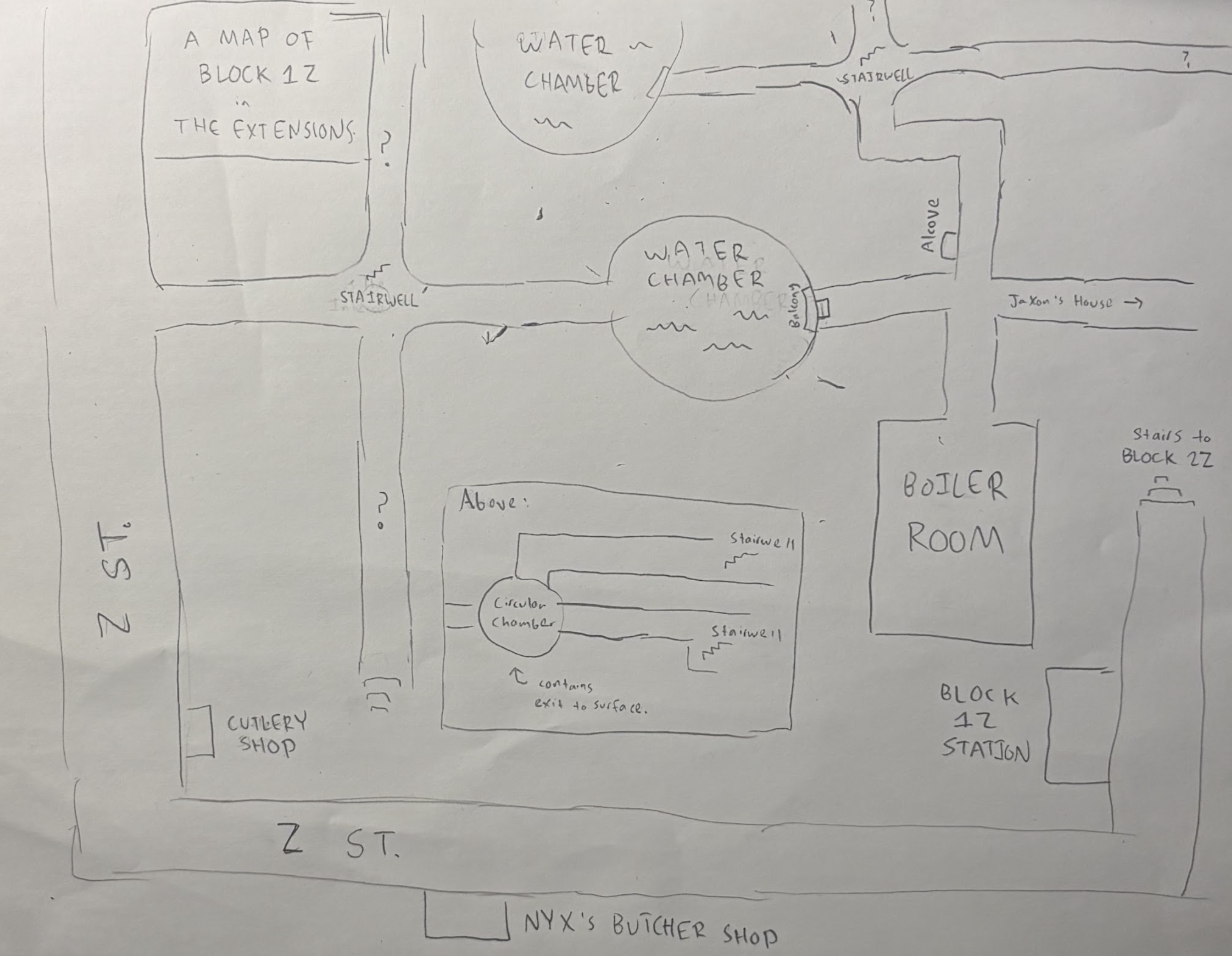
Image credit Sava Wallaert
QUOTE CREDIT: The passage quoted by James in Part Four is a real line from Peter David’s book Tigerheart. All credit goes to the author, Peter David.
AUTHOR’S NOTE: This will be my last contribution to the NewsCool Chronicle. I started my time here with a story (you can check it out here) and I wanted to end with a story as well. The narrative you have just read took me a week to write, and over this last week I’ve had plenty of time to reflect on my time at this paper. I’m so infinitely grateful that I was able to have this opportunity, and I feel like I’ve learned so much over the past year: about writing, editing, fact-checking, interviewing, and so much more.
I want to thank the elective’s wonderful teachers for showing up every semester and ensuring that the NewsCool Chronicle lives on. I also want to show my appreciation for all the students that were on the Chronicle with me, in both this semester and last. Looking back on all the articles we’ve written together, I see how much hard work you’ve put in. And now, thanks to the internet, our work will be preserved forever. I know I’ll be watching the website closely from high school, and reading every amazing piece the NCC produces.
And thank you, readers, for all being a part of this very special paper.